5 min read | Last Updated: July 28, 2026

|
Your containers might be the reason your meal prep tastes off. Not the recipe. Not the seasoning. The container absorbing last week's garlic, the cracked gasket letting air in, the plastic leaching at microwave temperature — these are all real things that affect how food tastes. Here are 7 signs your containers are working against you, and what to do about each one. |
You followed the recipe exactly. You seasoned it the same way. You used the same ingredients. But somehow, Sunday's chicken tastes nothing like it did last time — flat, slightly off, or vaguely like the container it sat in for three days.
The container is almost always the culprit. Here is how to spot the problem.

🔍 What Problem Are You Having?
👃 Smells like old food
This is an odor absorption problem. Plastic is slightly porous and absorbs volatile compounds from strongly flavored food — garlic, curry, fish. Those compounds come back out into whatever you store next. Glass does not absorb anything.
💡 Quick fix: baking soda paste overnight. Long-term fix: switch to glass containers — they never absorb odors. See Sign 1 below for the full detail.
😕 Plastic aftertaste
When plastic is microwaved, heat accelerates the release of compounds from the plastic into the food. Older and scratched containers are worse. This is the classic plastic aftertaste.
💡 Fix: never microwave in plastic — transfer to glass or a plate first. Borosilicate glass containers release nothing at any temperature. See Sign 2 below.
😶 Tastes bland by day 3
Oxidation from a failing seal flattens flavor. The volatile compounds that make food taste good slowly escape when air gets in. The container looks fine but the gasket has compressed and is no longer airtight.
💡 Fix: do the tilt test — half-fill with water, close, tilt 45 degrees for 30 seconds. Any seepage = replace the gasket. See Sign 3 below.
🔴 Permanent staining
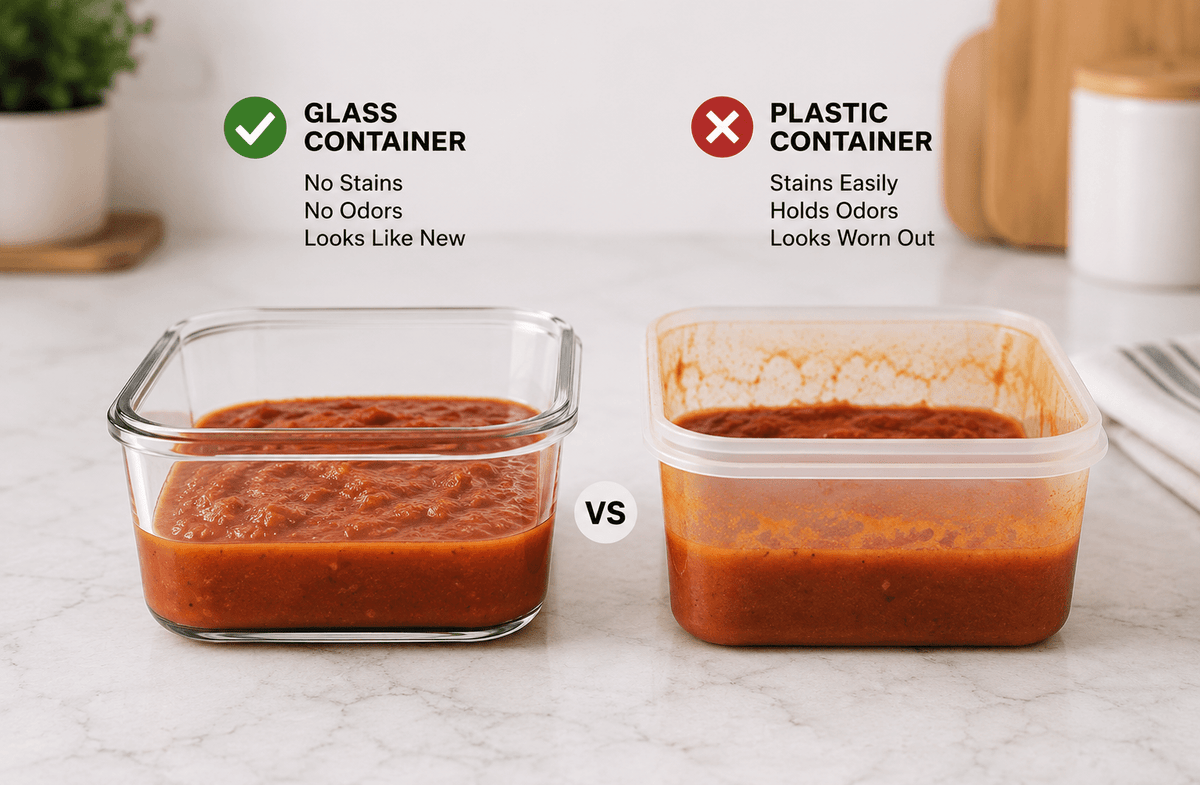
Tomato, turmeric, and beet pigments bond with plastic polymer chains and become embedded in the container wall. The container has absorbed those flavor compounds too — they transfer to new food.
💡 Fix: if staining comes with smell transfer, replace the container. Use glass for tomato and curry meals — glass never stains. See Sign 4 below.
💧 Liquid pooling
Excess headspace means more air, which draws moisture out of food through evaporation inside the container. The protein dries out and flavor concentrates in the liquid below.
💡 Fix: match container to portion — food should fill it to within an inch of the lid. 800ml for standard portions without sauce, 1040ml with sauce.
🧊 Food drying out
Press-fit lids are not airtight — they create a friction seal that degrades with use. Without a snap-lock silicone gasket, air exchanges continuously and food dries out within days.
💡 Fix: check if your lid has a silicone ring and locking clips. Press-fit only = not airtight. Snap-lock with gasket = properly sealed.
⏰ Fine day 1, off by day 4
These are different problems. Failing seal = food goes off faster than it should. Freshness window = food was stored correctly but is at its quality limit. The smell test tells you which one it is.
💡 Fix: smell before opening. Off smell from outside = seal issue. Normal smell but flat taste = freshness window reached. Cooked chicken is good for 3 to 4 days max.
|
👃 Sign 1: Your Food Smells Like Last Week's Meal The container absorbed more than just the food |
Open an empty, clean container. Take a sniff. If you can smell anything — garlic, curry, fish, anything — the container has absorbed those volatile compounds into its walls. And now it is releasing them back into whatever you store next.
This is almost exclusively a plastic problem. Plastic is slightly porous at a molecular level. Over time it absorbs the volatile organic compounds in strongly flavored food — the same molecules that create smell and taste. Glass does not do this. Glass is non-porous and chemically inert.
|
🔬 Fun Fact: A 2021 study found that polypropylene containers stored curry for 3 days retained measurable levels of curcumin and volatile aromatic compounds in the plastic walls even after washing. Glass containers stored the same curry and showed zero compound retention after washing. |
|
The Fix
|

|
😕 Sign 2: Your Food Has a Faint Plastic Aftertaste Especially after microwaving |
You reheat your meal, take a bite, and there is a faint chemical or plastic note underneath the food flavor. This is plastic leaching. When plastic is heated in a microwave, the heat accelerates the release of compounds from the plastic into the food.
Not all plastic containers leach equally. Higher-quality BPA-free containers leach less than old, scratched, or low-quality ones. But all plastic containers show some degree of this under heat.
|
🔬 Fun Fact: The FDA's microplastics research program (2026) confirmed that microwave heating of plastic food containers increases the migration of plastic-derived compounds into food compared to room temperature storage. The effect is more pronounced in scratched or worn containers. |
|
The Fix
|
|
😶 Sign 3: Your Food Tastes Bland or Flat by Day 3 The seal is letting air in |
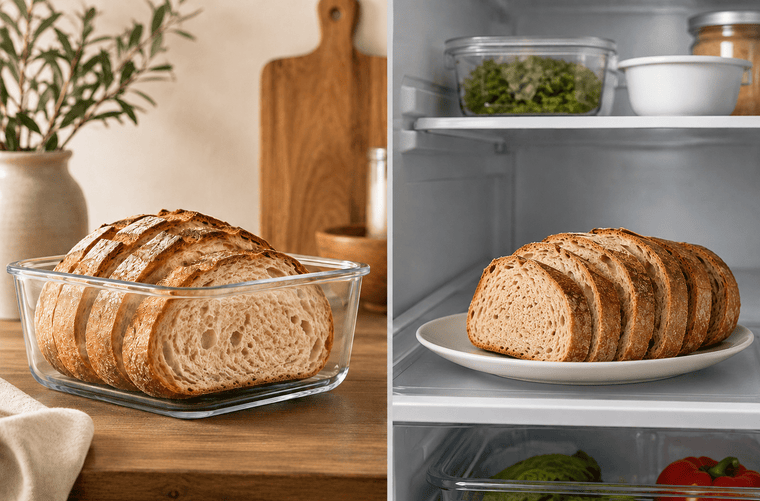
Fresh meal prep on Sunday, noticeably flatter by Wednesday. Not spoiled — just lacking the flavor it had when packed. This is oxidation from a compromised seal. When air gets in, the volatile flavor compounds that make food taste good slowly escape or break down.
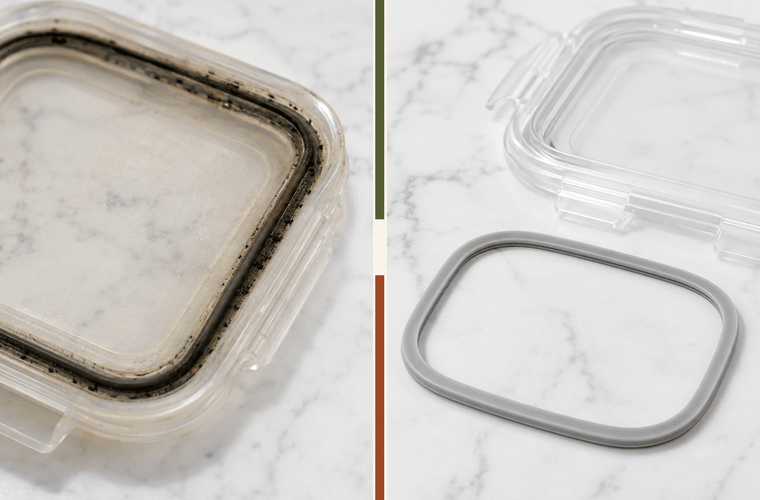
The most common cause is a gasket that has compressed over time and no longer creates a complete seal. It looks fine. It seems to close properly. But it is letting just enough air exchange happen to flatten the food over days.
|
How to Test Your Gasket
|
Replacement lids include a fresh silicone gasket — cheaper than a new set.
|
🔴 Sign 4: Your Container Looks Permanently Stained The plastic has bonded with the food |
Tomato sauce, turmeric, beet juice, curry these pigments bond with the polymer chains in plastic and become permanently embedded in the container wall. The container has also absorbed the volatile aromatic compounds in that food. Those come back out into the next meal.
The question is not how the stain looks it is what else those absorbed compounds are doing.
|
🔬 Fun Fact: Lycopene — the pigment that makes tomatoes red — is a fat-soluble compound that bonds strongly with polypropylene. This is why tomato sauce stains in plastic are so difficult to remove: the compound has entered the plastic matrix, not just sat on the surface. |
|
The Fix
|

|
💧 Sign 5: There Is Always Liquid Pooling at the Bottom The food is releasing moisture it should be keeping |
A small amount of liquid in the bottom is normal. But excessive liquid pooling means the food is losing moisture faster than it should — drying out the protein and concentrating the flavors in the liquid below.
Most common cause: the container is too large for the portion. Excess headspace above the food means more air, which draws moisture out through evaporation inside the sealed container.
|
The Fix
|
|
🧊 Sign 6: Food Tastes Freezer-Burned Even in the Fridge The container is not actually airtight |
Dry, leathery edges on proteins, papery texture on grains, muted flavor — all point to food drying out from continuous air exchange inside the container. Press-fit lids are not airtight. They create a friction seal that degrades every time you open and close the container.
|
🔬 Fun Fact: A press-fit lid and a snap-lock lid look similar from the outside. The difference is mechanical: a snap-lock lid with silicone gasket creates a closed environment. A press-fit lid relies on snug fit to slow air exchange — not stop it. Only the snap-lock maintains consistent freshness over weeks. |
|
The Fix
|
Why glass container lids stop sealing covers exactly how to test and what to replace.
|
⏰ Sign 7: The Food Is Fine on Day 1 and Wrong on Day 4 Failing seal or freshness window — these are different problems |
Meal prep food should taste comparable on day 4 as day 1 for most protein and grain combinations. If day 1 is great and day 4 is off, either the seal is failing or the food hit its freshness window. These need different fixes.
|
How to Tell Which It Is
|
How long does meal prep last covers every food type with exact timelines for glass-sealed storage.

The Quick Checklist: Run This Before Your Next Meal Prep
|
Each item below takes under 30 seconds. Run through it before packing Sunday's prep and catch the problems before they affect 5 days of food. |
-
Smell check: Open empty containers and sniff. Any smell = odor absorption issue.
-
Gasket check: Inspect the silicone ring. Cracks or flat compression = replace it.
-
Lid seal check: Half-fill with water, close, tilt 45 degrees for 30 seconds. Seepage = failing seal.
-
Scratch check: Look inside plastic containers. Significant scratching = more leaching risk.
-
Stain check: Staining with smell transfer = replace.
-
Size check: More than an inch of air above the food = size down.
-
Date check: Day 5 for proteins is the outer limit. Day 4 is safer.
|
🔬 Fun Fact: The average US household replaces plastic food storage containers every 14 to 18 months. Glass containers last 7 to 10 years with normal use. The annual cost of replacing plastic sets across that period exceeds the one-time cost of a quality glass set. |
If your containers failed more than two of these checks, glass food storage containers with lids are the straight upgrade. Our 5-day glass vs plastic test shows exactly what happens to each type over a real meal prep week.
Frequently Asked Questions
Why does my meal prep food taste weird?
The most common causes are containers absorbing odors, a cracked gasket allowing air in, plastic leaching when microwaved, and food past its safe window. Glass meal prep containers eliminate most of these because glass does not absorb odors or flavors.
Why does food taste like plastic from containers?
Plastic containers leach trace compounds into food when heated. Scratched containers are worse. Glass vs plastic food storage covers the full material comparison — glass is chemically inert at any temperature.
Can old meal prep containers make food taste bad?
Yes. Cracked gaskets speed up spoilage. Scratched plastic absorbs odors. Stained walls transfer previous meal compounds to new food. If your container smells when empty, it is affecting your food.
How do I get the smell out of my meal prep containers?
Plastic: baking soda paste overnight. Gaskets: soak in white vinegar for 30 minutes. Persistent smells: replace the container. How to remove smell from glass containers covers the full cleaning approach.
Are glass meal prep containers better than plastic for taste?
Yes. Glass does not absorb food flavors between uses. A glass container that stored garlic curry will not affect the chicken stored in it next. Plastic absorbs volatile compounds and re-releases them into subsequent meals.
How long is it safe to keep meal prep in containers?
Cooked proteins: 3 to 4 days. Cooked grains: 5 to 6 days. Cooked vegetables: 4 to 5 days. A failing gasket reduces all of these. Full meal prep freshness guide covers every food type with specific timelines.
Most meal prep taste problems are container problems — not recipe problems. The checklist above finds them in under 5 minutes. Razab glass meal prep containers are available in sets from individual portions to family-size batch cooking. No odor transfer, no staining, no plastic aftertaste. See the signs your glass container needs replacing if you already have glass and want to know when it is time for a refresh.
|
About the Author This guide was researched and written by the Razab Product Research Team. We tested borosilicate glass and food-grade plastic containers side by side across temperature cycling, microwave reheating, and long-term fridge storage. |
Conversation
Join the discussion