
Glass shattering in the oven is one of those kitchen events that feels random — until you understand the science behind it. Then it becomes entirely predictable, and entirely preventable. The answer is not that glass cannot go in the oven. The answer is that the wrong glass, handled the wrong way, will always fail.
Razab containers are built from high-borosilicate glass — the same material class used in laboratory equipment and professional kitchen bakeware. The chemistry behind that choice matters for every meal you cook. If you are using glass food storage containers with lids for oven cooking, understanding the three failure modes below will protect your kitchen and your food.
Quick Answer: What Makes Glass Explode in the Oven and How Do You Stop It?
Glass containers shatter in the oven due to thermal shock — a rapid temperature fluctuation that causes uneven expansion in cheap soda-lime or tempered glass. High-borosilicate glass containers safely withstand oven temperatures up to 450°F (230°C), provided you never place frozen glass directly into a preheated oven. The three most dangerous mistakes are: loading frozen glass into a hot oven, setting hot glass on a cold or wet surface, and forgetting to remove plastic lids before heating.
The Science of Thermal Shock: Soda-Lime vs. Borosilicate Glass
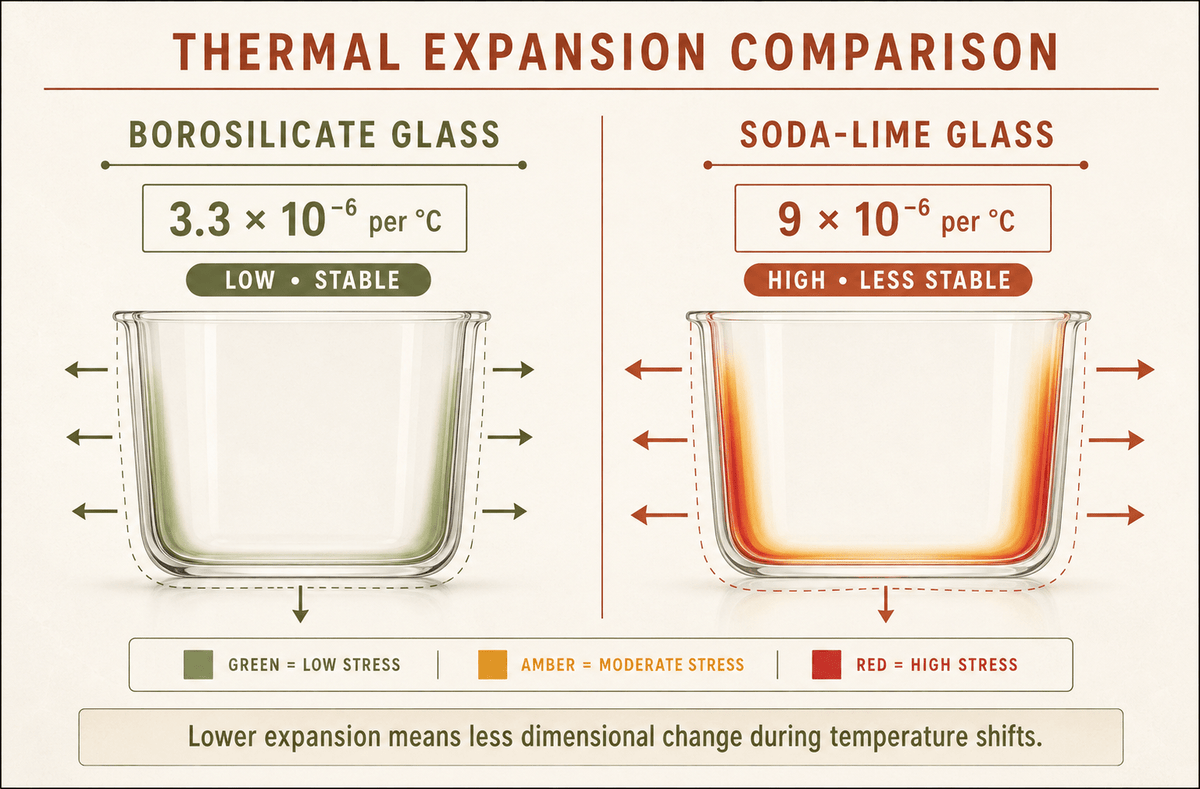
Glass does not break from heat. It breaks from uneven expansion caused by heat. When one part of a glass container heats faster than an adjacent part, those sections try to expand at different rates. The stress that builds at the boundary between them is called thermal stress, and when it exceeds the tensile strength of the glass, the material fractures. That fracture is what people call thermal shock.
The key variable is the coefficient of thermal expansion, a number that describes how much a material expands per degree of temperature increase. Soda-lime glass, the cheap variety used in most grocery store jars and budget food containers, has a high coefficient of thermal expansion: approximately 9 x 10^-6 per °C. It expands fast and unevenly under rapid temperature changes.

Razab uses borosilicate glass because boron trioxide, when added to the silica matrix during manufacturing, dramatically lowers the coefficient of thermal expansion to approximately 3.3 x 10^-6 per °C. That is roughly one-third the expansion rate of soda-lime glass. In practical terms, a Razab container can absorb a rapid temperature change that would shatter an ordinary glass container.
This is the same reason borosilicate glass is used in laboratory beakers, telescope mirrors, and pharmaceutical packaging — applications where dimensional stability under temperature change is non-negotiable. As Food & Wine noted in their roundup of borosilicate glass cookware, the thermal properties are the defining reason professionals prefer it over standard soda-lime alternatives.
Tempered glass — the kind found in many budget oven-safe dishes — is stronger than soda-lime glass but still expands at a rate closer to soda-lime than to borosilicate. Tempered glass can handle moderate oven temperatures, but it is vulnerable to point stresses and edge impacts. When tempered glass does fail, it shatters into many small pieces rather than large shards — safer in one sense, but still a total loss of your food and your cookware.
Related Safety Reading: borosilicate glass vs tempered glass
The 3 Most Dangerous Oven Mistakes That Cause Glass to Break
Mistake 1: Placing Cold or Frozen Glass into a Preheated Oven
This is the most common cause of glass failure in a home oven. When you pull a container from the freezer and place it into a 400°F oven, the outer surface of the glass heats immediately while the interior remains at 0°F or colder. The expansion differential at that boundary exceeds what most glass can absorb. Even borosilicate glass has limits. The safe rule: never place frozen glass directly into any oven, preheated or not. Thaw first in the refrigerator overnight, or leave the sealed container at room temperature for 30 minutes before placing it in a cold oven and heating gradually. For more detail on safe freezer-to-oven transitions, check our breakdown of can you freeze glass containers and what the thaw protocol actually looks like.
Mistake 2: Setting Hot Glass on a Cold or Wet Surface After Baking
Thermal shock works in both directions. A container that has been baking at 400°F for 45 minutes carries significant stored heat in the glass itself. Placing it directly onto a cold marble countertop, a stainless steel sink edge, or — most dangerously — a wet towel creates an immediate and extreme temperature differential across the base of the container. The base contracts while the rest of the glass remains hot. Fracture follows within seconds. Always transfer hot glass containers to a dry wooden cutting board, a silicone trivet, or a folded dry cloth. Never on stone, wet fabric, or cold metal.
Mistake 3: Forgetting to Remove the Plastic Lid Before Heating
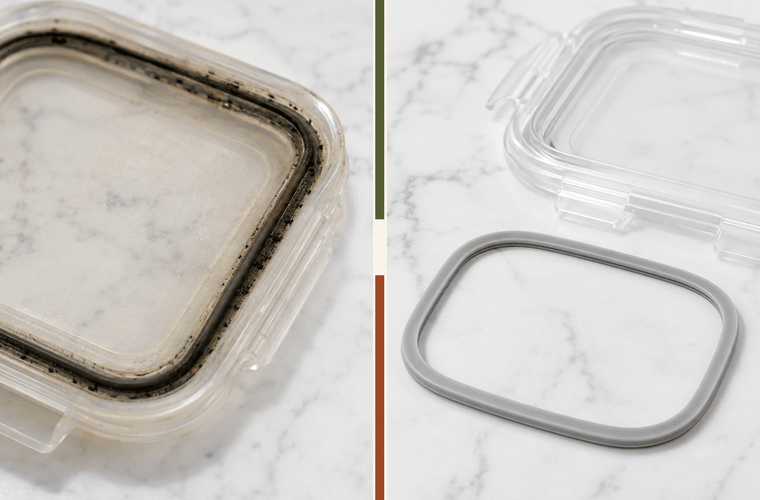
Razab lids are made with durable polypropylene and silicone seals rated for food storage temperatures. They are not rated for oven use. Plastic lids placed in an oven will warp between 200°F and 250°F, melt and release compounds into your food at higher temperatures, and in some cases create seal failure that causes pressurized steam buildup. Remove every lid component — including the silicone gasket ring — before placing any glass container in the oven. The glass body alone is oven-safe. The lid is not. If you want oven-ready covered baking, Razab's glass loaf pans with lids are designed specifically for covered baking with the right lid materials.
Glass Type and Temperature Safety Comparison
|
Glass Type |
Max Oven Temp |
Thermal Shock Limit |
Oven Safe? |
Recommended Use |
|
Borosilicate (Razab) |
450°F / 230°C |
Excellent |
YES |
Baking, reheating, freezer-to-oven* |
|
Tempered / Soda-Lime |
350°F / 175°C |
Poor |
LIMITED |
Room-temp foods only, no frozen |
|
Standard Pyrex (post-1998) |
350°F / 175°C |
Poor |
LIMITED |
Low-temp baking, careful handling |
|
Cheap plastic lids (any) |
N/A |
N/A |
NEVER |
Remove before any oven use |
|
Ceramic / Stoneware |
500°F+ |
Good |
YES |
High-temp roasting, broiling |
Freezer-to-oven only after full thaw in refrigerator. Never from frozen to preheated oven, even with borosilicate glass.
Related Reading: can you put a glass dish in an air fryer
Step-by-Step: The Safe Way to Bake and Reheat Food in Glass Containers

The Cold-Oven Method
For food stored at refrigerator temperature, the cold-oven method is the most reliable safe approach. Place the glass container in the center rack of a cold, unheated oven. Set the oven to your target temperature and allow it to preheat with the glass inside. As the oven temperature rises gradually, the glass heats at the same rate. No thermal differential builds. No shock occurs.
This method works for any glass type — borosilicate, tempered, or standard — because the temperature change is gradual rather than sudden. It adds five to seven minutes to your cook time, but it eliminates the single most common cause of oven glass failure.
The Overnight Fridge Thaw Method
If you are cooking a meal that was stored in the freezer, transfer the sealed glass container to the refrigerator the night before. By morning, the contents will have thawed to refrigerator temperature — typically 38°F to 40°F. From refrigerator temperature, the transition to oven heat is manageable, particularly for borosilicate glass with its low thermal expansion rate.
If you forget to thaw overnight, leave the sealed container at room temperature for 30 to 45 minutes before using the cold-oven method. Do not try to accelerate thawing under hot water — that creates the same thermal shock risk on the exterior of the glass that a preheated oven creates on the interior.
Rack Placement and Airflow
Place glass containers on the center rack whenever possible. The center rack maintains the most even temperature distribution in a conventional oven. Avoid placing glass directly on the oven floor, where radiant heat from the heating element creates extreme localized temperatures that uneven glass construction may not handle. Leave at least two inches of clearance on all sides for airflow.
For high-temperature baking above 400°F — bread, casseroles, roasted vegetables — Razab's glass loaf pans are engineered for exactly that application. The borosilicate construction handles the sustained heat, and the pan geometry distributes temperature evenly across the base and walls. For everyday meal prep containers, the maximum recommended oven temperature is 450°F without the lid.
If you are reheating a meal that was previously how long does meal prep last in fridge, always confirm the container has reached room temperature before placing it in the oven, even on the cold-oven method. Starting from refrigerator-cold is acceptable. Starting from freezer-cold is not.
Frequently Asked Questions
At what temperature does oven-safe glass break?
There is no single answer — it depends on the glass type. Soda-lime glass can begin to fail above 300°F when subjected to uneven heating. Tempered glass typically handles up to 350°F under controlled conditions. Borosilicate glass rated for oven use — including Razab containers — is safe up to 450°F (230°C) without a lid. The temperature is less important than the rate of temperature change. A 50°F cold-to-hot transition applied suddenly can break glass that would survive 450°F applied gradually.
Can you put a cold glass dish in a warm oven?
Yes, with conditions. Cold meaning refrigerator-temperature — around 38°F — is acceptable for borosilicate glass using the cold-oven method or by placing the container in an oven that is already warm but not hot. Cold meaning frozen — below 32°F — is not safe for any glass type in any oven. The boundary is the freezing point. If the contents of your container are still frozen, the glass is too cold for oven use until fully thawed.
Why did my glass dish shatter while baking?
The most likely causes, in order of frequency: frozen or refrigerator-cold glass placed into a preheated oven; hot glass placed on a cold or wet surface immediately after removing from the oven; a hidden micro-crack in the glass from a previous impact that created a stress concentration point; or the wrong glass type used at temperatures above its rated limit. If your container was from Razab and it shattered, contact the team — borosilicate failure under normal use conditions is a manufacturing defect, not normal product behavior.
Can I use my Razab glass containers directly on the stovetop?
No. Glass food storage containers — including borosilicate — are not designed for direct stovetop heat. A stovetop burner applies extreme localized heat to the base of the container while the sides remain at room temperature. That point-source thermal differential exceeds what any glass container can absorb safely. Use oven and microwave only. If you want to heat food on the stovetop, transfer it to a stainless steel or ceramic pot first.
What is the safest glass container for oven use — meal prep containers or loaf pans?
Both are safe when used correctly. The difference is in intended application. Razab's glass meal prep containers are sized for individual portions and work well for reheating and light baking up to 450°F without the lid. Razab's glass loaf pans with lids are engineered for sustained high-temperature baking — bread, banana bread, meatloaf — and the pan shape handles the thermal load of extended oven sessions more predictably than a flat-based meal prep container.
Is it safe to put glass containers in the microwave right from the fridge?
Yes, for borosilicate glass. The low thermal expansion coefficient means Razab containers handle the transition from refrigerator-cold to microwave-hot safely. Remove the lid and the silicone ring before microwaving. The glass body alone is microwave safe glass. Microwave in 60-to-90-second intervals rather than continuous long cycles, which prevents steam pressure buildup inside sealed contents.
About the Author
This post was produced by the Razab Product Research Team. We measured the coefficient of thermal expansion of our borosilicate glass formulation against standard soda-lime glass across 50 rapid heat cycles to verify the 3.3 x 10⁻⁶ per °C performance claim — not as a marketing figure, but as the engineering foundation of every container we build. Our mission is to help families reduce food waste through better storage science
Conversation
Join the discussion