5 min read | Last Updated: July 29, 2026

|
1 US cup equals exactly 236.588ml — rounded to 237ml for everyday use. Per the National Heart, Lung, and Blood Institute, 1 cup = 8 fluid ounces = 237ml. The USDA confirms 4 cups = 1 quart = 946.36ml, which divides to 236.59ml per cup. For practical cooking and meal prep, always use 237ml as the working number for 1 US cup. |
1 US cup = 237ml. That is the answer. If you are converting a recipe — done. If you want to know exactly how many cups fit in every Razab glass container, the full table is below. And if you have seen 240ml or 250ml listed as 1 cup somewhere — keep reading, because both are wrong for US recipes and the difference matters in baking.

The Official Answer: Where 237ml Comes From
|
1 US cup = 236.588ml exactly. Rounded to 237ml for practical use. This is a US federal measurement standard. 1 cup = 8 fluid ounces. 1 fluid ounce = 29.5735ml. Multiply: 8 × 29.5735 = 236.588ml. |
The National Heart, Lung, and Blood Institute (NIH) defines standard US cooking measurements: 1 cup = 8 fluid ounces. The USDA Food Buying Guide confirms the metric equivalent: 1 quart (4 cups) = 946.36ml, which divides to exactly 236.59ml per cup. Both federal sources align at 237ml when rounded to the nearest whole milliliter.
America's Test Kitchen, which has tested US-to-metric conversions in professional recipe development for decades, uses 237ml as the standard working value for 1 US cup in all recipe conversions. Their measurement guide notes that 236ml, 237ml, and 240ml are all acceptable for cooking but in baking, the extra 3ml from 237 to 240 compounds across multiple cups and can affect rise and texture in precision recipes.
|
The Three Numbers You Will See — What Each Means
|
|
💡 Did You Know? The US cup was standardized at exactly 8 US fluid ounces in 1896 by Fannie Farmer in her Boston Cooking School Cook Book — the first American cookbook to use standardized measurements instead of 'a teacup of flour' or 'a wine glass of milk.' Before that, home cooks used whatever cup was available, and recipes varied wildly. The 237ml we use today traces directly back to that 1896 standardization. |
Complete Cups to ml Conversion — With Every Razab Container
|
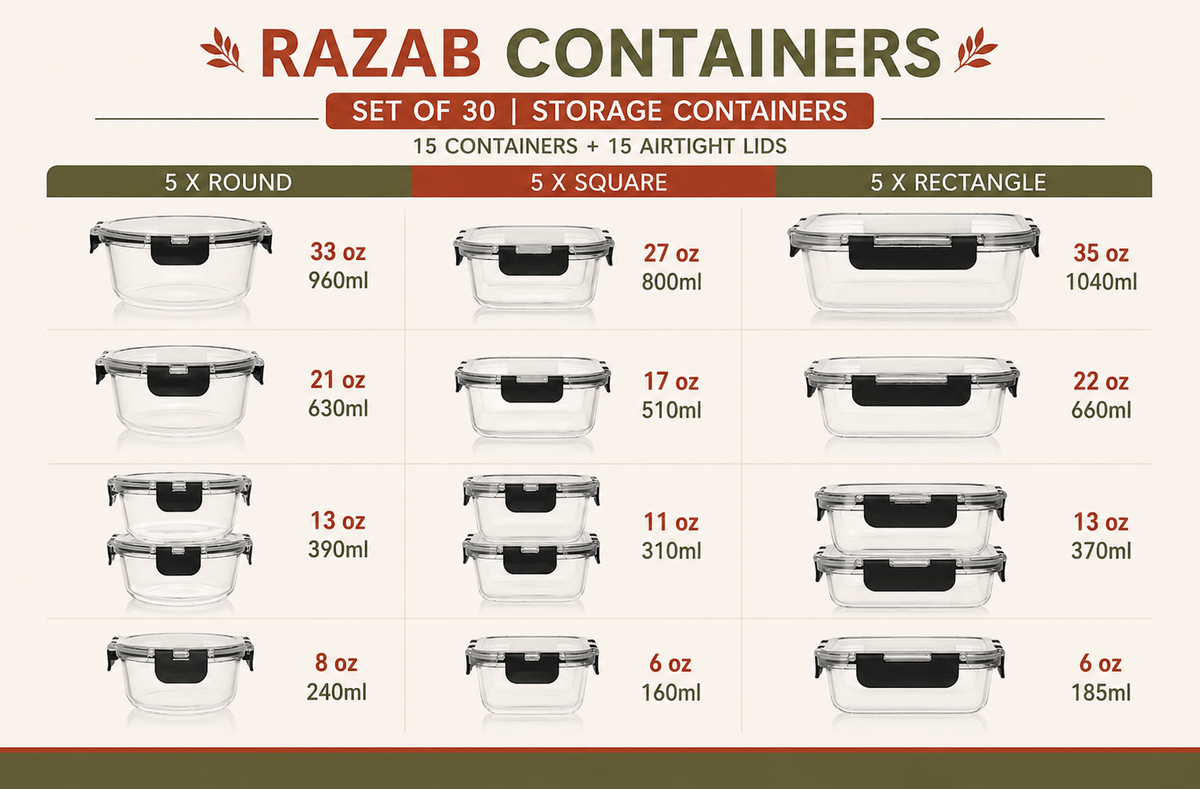
Every Razab glass container size from 320ml to 2700ml converted to US cups and fluid ounces. The highlighted row at 800ml (3.38 cups) is the standard single meal prep portion. The 32 oz row shows where the most commonly searched size falls in the Razab range. |
|
Cups |
Fluid Oz |
Milliliters |
Closest Razab Container |
Best For |
|
¼ cup |
2 oz |
59 ml |
Use 320ml with small fill |
Sauces, dressings, dips |
|
⅓ cup |
2.7 oz |
79 ml |
Use 320ml with small fill |
Small ingredient portions |
|
½ cup |
4 oz |
118 ml |
320ml (10.8oz) square |
Snack portions, nut butters |
|
⅔ cup |
5.3 oz |
158 ml |
320ml (10.8oz) square |
Small sides, sauces |
|
¾ cup |
6 oz |
177 ml |
320ml (10.8oz) square |
Yogurt, hummus, dips |
|
1 cup |
8 oz |
237 ml |
370ml (12.5oz) rectangular |
Single-serve oats, soup portions |
|
1½ cups |
12 oz |
355 ml |
400ml (13.5oz) square |
Overnight oats base, sides |
|
2 cups |
16 oz |
473 ml |
520ml (17.6oz) square |
Side dishes, veg portions |
|
2.5 cups |
20 oz |
591 ml |
640ml (22oz) rectangular |
Overnight oats with toppings |
|
3 cups |
24 oz |
710 ml |
640ml (22oz) rectangular |
Light meals, smoothies |
|
3.4 cups |
27 oz |
800 ml |
800ml (27oz) square — exact |
Meal prep bowl, no sauce |
|
4 cups |
946 ml |
1040ml (35oz) rectangular — closest |
Meal with sauce, salads, pasta |
|
|
4.4 cups |
35 oz |
1040 ml |
1040ml (35oz) rectangular — exact |
Full meal prep bowl with sauce |
|
5 cups |
40 oz |
1183 ml |
1200ml (40.5oz) square |
Large portions, two sides |
|
6.5 cups |
52 oz |
1538 ml |
1520ml (52oz) rectangular |
Batch proteins, two portions |
|
11.4 cups |
91 oz |
2690 ml |
2700ml (91oz) rectangular |
Full-week rice or grain batch |
Two rows to bookmark: 800ml = 3.38 cups (the standard dry meal prep portion — chicken, rice, vegetables without sauce) and 1040ml = 4.4 cups (the standard sauce-heavy meal prep portion — pasta, curries, soups). These two container sizes cover 80 percent of all meal prep use cases. Which container size fits each meal prep portion tested every common meal in physical portions to confirm this.

Is 250ml the Same as 1 Cup? The Most Common Confusion
|
No. 250ml is not the same as 1 US cup. 1 US cup = 237ml. The 250ml figure comes from metric cups used in Australia, Canada, and some other countries. The difference is 13ml per cup — small in cooking, meaningful in baking when it compounds across multiple cups. |
This is the single most common ml-to-cups confusion in US kitchens — and it almost always comes from following an Australian or Canadian recipe without realizing the cup size is different. Australian baking blogs are extremely popular in the US, and their recipes use 250ml cups throughout.
The practical test: if a recipe comes from a US source (AllRecipes, Food Network, Serious Eats, America's Test Kitchen, USDA) — use 237ml. If it comes from an Australian, New Zealand, or Canadian source — use 250ml. The easiest way to tell is to check if the recipe lists butter in sticks (US) or grams (metric countries).
|
💡 Did You Know? The 13ml difference between a US cup (237ml) and a metric cup (250ml) adds up. In a recipe calling for 3 cups of flour, the metric cup gives 39ml more flour — roughly 2 extra tablespoons. In bread baking, that much extra flour can change the hydration percentage enough to affect rise and crumb structure. It rarely ruins a recipe, but it is why professional bakers weigh ingredients in grams rather than measuring in cups. |
Every Common Cup Fraction in ml — Baking Reference
|
The fractions used in baking recipes — ¼ cup, ⅓ cup, ½ cup, ⅔ cup, ¾ cup — all convert to specific ml values. These are the measurements most recipes use, and the conversions most people need mid-bake. |
¼ cup = 59ml. ⅓ cup = 79ml. ½ cup = 118ml. ⅔ cup = 158ml. ¾ cup = 177ml. 1 cup = 237ml. 1½ cups = 355ml. 2 cups = 473ml.
|
Quick Fractions Reference Card
|
How Many Cups Is [X] ml? The Reverse Conversions
|
To convert ml to cups: divide by 236.588. Or divide by 237 for quick mental math. The most commonly searched reverse conversions: 800ml, 1000ml, 500ml, and 400ml. |
How many cups is 500ml?
500ml = 2.11 cups (500 ÷ 236.588 = 2.113). Closest Razab container: 520ml (17.6oz) rectangular, which holds approximately 2.2 cups. The 520ml is the right size for large side dishes, vegetable portions, or two-cup smoothie prep.
How many cups is 750ml?
750ml = 3.17 cups (750 ÷ 236.588 = 3.170). Falls between the 640ml (2.7 cups) and 800ml (3.38 cups) Razab containers. For a 750ml portion, the 800ml container is the better fit — the extra 50ml gives headspace without excess air.
How many cups is 800ml?
800ml = 3.38 cups = 27 fl oz. The Razab 800ml square container is the most popular single-portion meal prep size — fits a standard chicken and rice bowl without sauce, and is the recommended starting container for meal prep for weight loss at 350 to 500 calories per portion.
How many cups is 1000ml (1 liter)?
1000ml = 4.23 cups (1000 ÷ 236.588 = 4.227). The closest Razab container is the 1040ml (35oz) rectangular, which holds 4.4 cups. For how many cups are in 32 oz — the separate guide covers the oz-to-cups conversion in detail with the same Razab size reference.
How many cups is 1200ml?
1200ml = 5.07 cups. The Razab 1200ml (40.5oz) square container holds approximately 5 cups — the right size for large family-portion main dishes or two-person meal prep in one container.
Cups to ml in Baking: Why Volume and Weight Are Different

|
For liquids, 1 cup always equals 237ml regardless of what the liquid is. For dry ingredients, 1 cup is a volume measurement — but the weight in grams varies dramatically by ingredient. A cup of flour weighs 120-130g. A cup of sugar weighs 200g. A cup of oats weighs 90g. Same volume, very different weights. |
|
Baking Ingredient |
US Cups |
Milliliters |
Note |
|
All-purpose flour (1 cup) |
1 cup |
125g / ~237ml volume |
Flour is measured by weight in professional baking. 1 cup flour ≠ 237ml because flour compresses. Spoon and level — never scoop. |
|
Granulated sugar (1 cup) |
1 cup |
200g / 237ml volume |
Sugar pours freely — measures accurately by volume. 1 US cup = 237ml = 200g granulated sugar. |
|
Brown sugar (1 cup packed) |
1 cup packed |
220g / 237ml volume |
Must be packed firmly into cup. Unpacked brown sugar gives 20-30% less by weight. |
|
Butter (1 cup) |
1 cup |
227g / 237ml |
Butter is solid — 1 US cup = 2 sticks = 227g. Volume and weight both valid for butter. |
|
Milk or liquid (1 cup) |
1 cup |
237ml exact |
All liquids: 1 US cup = 237ml exactly. No variation. |
|
Honey or maple syrup (1 cup) |
1 cup |
340g / 237ml volume |
Denser than water — weighs more but still 237ml volume. Measure by volume (ml) for accuracy. |
|
Rolled oats (1 cup) |
1 cup |
90g / 237ml volume |
Oats are light and irregular — measure by volume. 1 cup dry oats expands to nearly 2 cups cooked. |
The most important baking conversion to get right: flour. 1 cup of all-purpose flour is a volume of 237ml but weighs approximately 120 to 130 grams — not 237 grams. Scooping flour directly from the bag packs it and gives 150 to 160g per cup — 20 to 30 percent more than the recipe intends. The correct technique is to spoon flour into the measuring cup and level with a straight edge. This is why professional bakers weigh flour in grams rather than measuring in cups.
If you are scaling up a baking recipe from cups to a large glass container batch — say, baking a double or triple recipe to fill a glass loaf pan — always convert cups to grams for dry ingredients, not cups to ml. 2 cups of flour is 240 to 260 grams, not 473ml of flour.
Frequently Asked Questions
How many ml in a cup?
1 US cup = exactly 236.588ml, rounded to 237ml. Per NIH measurement standards, 1 cup = 8 fluid ounces. The USDA confirms 4 cups = 946.36ml, dividing to 236.59ml per cup. Always use 237ml as the working number for US recipes.
Is 250ml the same as 1 cup?
No. 1 US cup = 237ml. 250ml is the metric cup used in Australia, Canada, and New Zealand. For US recipes, use 237ml. For Australian or Canadian recipes, use 250ml. The 13ml difference compounds in baking.
How many cups is 240ml?
240ml is approximately 1 cup — 3ml more than the exact US measurement of 237ml. For cooking, 240ml and 1 cup are interchangeable. For precision baking, 237ml is the exact standard.
How many ml is 2 cups?
2 US cups = 473ml (2 × 236.588ml = 473.176ml). In Razab containers, 2 cups fits in the 520ml (17.6oz) rectangular container with minimal headspace. For the full cups and oz conversion table, how many cups in 32 oz covers every common measurement with Razab container sizes.
How many cups is 800ml?
800ml = approximately 3.38 cups (800 ÷ 236.588). The Razab 800ml square container holds 3.38 cups — the standard single meal prep portion for a protein and grain bowl without sauce. Which container size fits each meal prep portion confirmed this in physical testing across 8 common meals.
How many cups is 1000ml?
1000ml (1 liter) = approximately 4.23 cups. The closest Razab container is the 1040ml (35oz) rectangular, holding 4.4 cups. Browse Razab glass meal prep containers — available from 320ml (1.35 cups) to 2700ml (11.4 cups).
1 US cup = 237ml — confirmed by NIH and USDA federal standards. Every Razab glass container size in cups is in the table above, from 320ml (1.35 cups) to 2700ml (11.4 cups). Glass food storage containers with lids are available in sets covering every portion size. For how long food stays fresh in each size, how long does meal prep last covers every food type with specific timelines — and how many containers you actually need for a full week without running short.
|
About the Author Produced by the Razab Meal Prep Research Team. All measurement conversions in this guide are verified against NIH federal standards and the USDA Food Buying Guide. Razab is a woman-owned brand, designed in New York and trusted by over 1 million US families since 2017. |
Conversation
Join the discussion