
|
A glass container lid not sealing is almost always caused by one of six things: a worn silicone gasket, food residue on the rim, a warped lid, incorrect clip order on 4-lock lids, hot food stored too soon, or a misaligned lid. Most fixes take under two minutes and do not require replacing the container. |
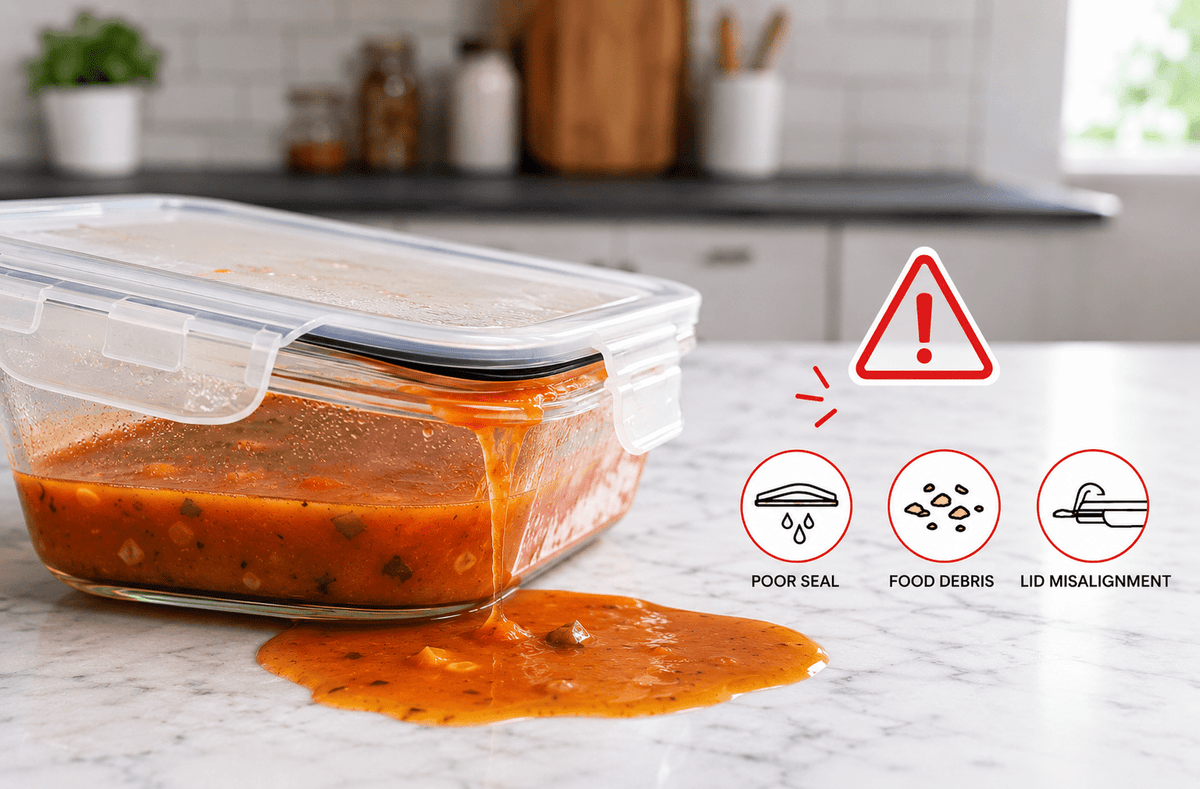
You packed soup for lunch, pressed the lid down, heard it snap. Then you opened your bag at work to find your shirt soaked and your container empty. The lid looked closed. It was not.
This is one of the most common glass container complaints — and one of the least-written-about. Most people throw the lid away, or worse, throw out the whole container. Neither is necessary in most cases.
Here is what is actually going on, and how to fix it. If your glass meal prep container lid will not seal properly, what you should do depends on which of these six problems you are dealing with.
6 Reasons Your Glass Container Lid Is Not Sealing
|
The most common reasons a glass container lid stops sealing are a degraded silicone gasket, food debris on the rim groove, a warped lid from heat exposure, wrong clip order on 4-point locking lids, steam pressure from hot food, and a lid that is sitting slightly off-center. Each has a specific fix. |
1. The Silicone Gasket Has Worn Out
This is the most common reason, especially after a year or more of regular use. The gasket is the rubber ring inside the lid that creates the actual seal. Over time, repeated dishwasher cycles degrade silicone. It becomes stiff, loses its flexibility, and no longer presses firmly against the container rim.
To check: press the gasket with your finger. It should feel soft and springy. If it feels hard, has visible cracks, or has shrunk away from the groove in any spot, the gasket is the problem.
Most people do not realize silicone degrades from heat, not from use. The dishwasher is the main culprit, not how often you open and close the lid.
2. Food Residue Is Blocking the Seal
Even a thin layer of dried sauce or oil on the container rim or the lid groove creates a micro-gap. The lid snaps shut but the seal is broken at that one spot. That is enough for liquid to push through under pressure.
Fix: grab a toothbrush and run it along the rim groove of the lid and around the glass food storage container rim. Rinse both under warm water and try again. This solves the problem in about 80% of cases where the lid snaps shut but still leaks.
3. The Lid Warped from Heat
Plastic lid components warp in the dishwasher's high-heat drying cycle, especially when the lid lands face-down and traps steam underneath. A warped lid looks flat but sits unevenly on the glass rim.
Does the dishwasher dammeal preage glass container lids? Yes, specifically the plastic frame and clips over time. Hand washing lids extends their lifespan significantly. Also: never microwave food with the lid on. The steam has nowhere to go and pushes the lid frame outward.
4. Wrong Clipping Order on 4-Lock Lids
If your lid has four clips, the order you snap them matters. Most people clip the first two clips on one side, then the other two. This creates uneven tension across the lid and leaves a gap on one edge.
The right way: snap opposite sides first. Lock the long side, then the opposite long side, then the two short sides. This distributes pressure evenly across the seal and closes every point of the rim at once.
5. Hot Food Stored Directly
Steam from hot food creates pressure inside a sealed container. If you seal the lid while food is still steaming, that pressure builds against the gasket from the inside and can push the seal open at its weakest point.
Let food cool for 15 to 20 minutes before sealing. The lid is not failing. The physics of hot steam is working against it.
6. The Lid Is Slightly Misaligned
Glass rims are not perfectly symmetrical. A lid that is rotated even a few degrees off-center will not seat correctly. It snaps shut but one edge lifts slightly.
Fix: lift the lid completely off, rotate it 90 degrees, reseat it, and try closing again. Try all four rotations if needed. This takes 10 seconds and solves misalignment every time.

How to Check If Your Silicone Gasket Is the Problem
|
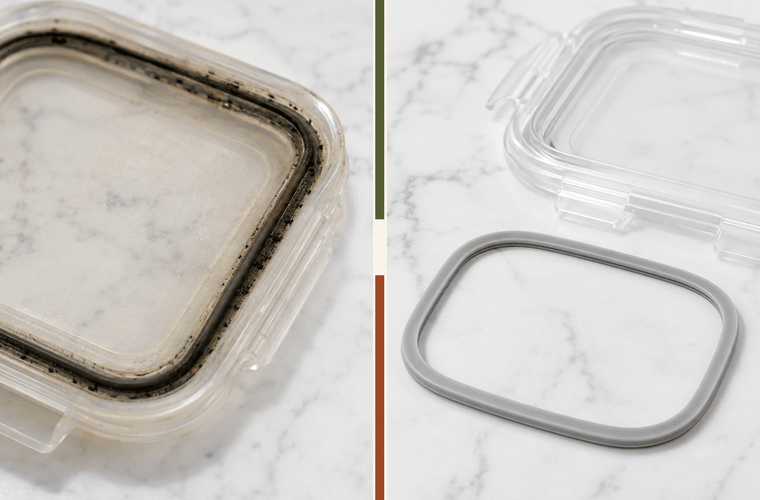
Three signs confirm the gasket is the issue: visible cracks or white discoloration on the rubber, a gasket that feels hard rather than soft and pliable, and a gasket that has pulled away from the lid groove in any spot. A gasket that absorbs food smells after cleaning is also degraded and should be replaced. |
Pull the gasket out of the groove if it is removable. Flex it between your fingers. Fresh silicone bends easily and springs back. Degraded silicone resists bending or cracks slightly when flexed.
The smell test is underused: if the gasket still smells like food after washing, it has absorbed oils and moisture into its structure. That means the silicone is no longer food-safe and no longer sealing properly. Replacing it is the only fix.
Fit test: press the gasket back into the groove. Run your finger along the full channel. It should sit flush with no raised sections and no gaps at the corners. Any spot where it sits proud of the groove means the gasket has changed shape.
Easy Fixes to Try Before Replacing Your Lid
|
Before replacing anything, try these four steps in order: clean the rim and lid groove with a toothbrush, remove the gasket and soak it in warm water for 10 minutes before reseating, rotate the lid 90 degrees and reseat it, and stop putting lids in the dishwasher. These four steps resolve most sealing issues without spending a dollar. |
Start with the toothbrush clean. It costs nothing and works most of the time. Dry food residue in the rim groove is invisible to the eye but enough to break the seal.
If that does not fix it, remove the gasket entirely. Soak it in warm water for 10 minutes. This softens stiffened silicone and lets it expand back toward its original shape. Dry it and press it firmly back into the groove. Try the seal again.
Still not sealing? Rotate the lid before reseating it. If it seals at a 90 degree rotation but not the original position, the lid frame has warped slightly and the rotated position is compensating. That works fine as a long-term solution.
The single habit that prevents all of this: hand wash the lids. The dishwasher is convenient but it shortens lid life faster than any other factor. A lid washed by hand lasts years longer than one run through a high-heat drying cycle weekly.
Quick Fix Reference
|
Problem |
Fix |
|
Lid snaps shut but still leaks |
Clean rim groove with toothbrush |
|
Gasket feels hard or cracked |
Replace gasket or lid |
|
Lid warped from dishwasher |
Hand wash only going forward; replace if warped |
|
4-clip lid not sealing evenly |
Snap opposite clips first, not same-side clips |
|
Steam pushing lid open |
Cool food 15 to 20 min before sealing |
|
Lid won't sit flat on rim |
Rotate 90 degrees, reseat, try again |
|
Razab Replacement Lids If your current lid is beyond the fixes above, Razab replacement lids fit the full Razab glass container range. Silicone-sealed, BPA-free, and built with the same 4-point locking system. Available on razab.com and Amazon. |

When to Replace the Gasket or the Lid Entirely
|
Replace the gasket when it is visibly cracked, permanently stiff after soaking, has shrunk away from the groove, or retains food smells after washing. Replace the lid when the plastic frame has visibly warped, clips are broken, or the gasket groove itself is damaged. You do not need to replace the whole container set. |
A gasket that smells, cracks, or no longer sits flush is past the point of any fix. Silicone is durable but not permanent. Two to three years of regular use, especially with dishwasher exposure, is a reasonable lifespan for a gasket before it needs replacing.
Broken clips are a lid problem, not a gasket problem. If one of the four clips no longer snaps into place or feels loose when closed, the clip is fatigued and the lid will never seal reliably again regardless of gasket condition.
Is it worth replacing the lid or buying new glass containers? In almost every case, just replace the lid. The glass itself lasts indefinitely. A new lid costs a fraction of a full set and solves the problem completely. Razab replacement lids fit the full glass container range and are available with the same silicone seal design as the original.
FAQs
My glass container closes but still leaks — why?
The most likely cause is food residue in the rim groove creating a micro-gap, or a gasket that has degraded and no longer presses flush against the rim. Clean the groove with a toothbrush first. If it still leaks, check whether the gasket feels hard or has visible cracks. Those are signs it needs replacing.
Does the dishwasher damage glass container lids?
Yes, over time. The high-heat drying cycle degrades silicone gaskets and can warp plastic lid frames. The glass container itself handles the dishwasher fine. The lid components are the vulnerable part. Hand washing lids significantly extends how long they seal properly.
How long do silicone gaskets last on glass containers?
With regular use and hand washing, a silicone gasket typically lasts two to three years before it stiffens or loses its seal. Dishwasher use shortens that to 12 to 18 months in many cases. If the gasket feels hard or smells after washing, it has reached the end of its useful life.
Is it worth replacing the lid or should I just buy new glass containers?
Replace the lid, not the whole set. Glass containers are built to last years and the sealing issue is almost always a lid or gasket problem. A replacement lid costs a fraction of a new container set and solves the problem completely.
Why does my glass container keep leaking even when I close it?
If the lid snaps shut but the container still leaks, the issue is usually one of three things: food residue blocking the seal at one point on the rim, a gasket that has lost its flexibility and is no longer pressing flat, or a lid that is slightly misaligned. Try cleaning the groove, rotating the lid 90 degrees, and checking gasket condition before replacing anything.
Can I use my glass container if the gasket is slightly damaged?
Not for liquids or soups. A damaged gasket will not maintain an airtight seal, which means leaks are likely. For dry foods, a compromised gasket is less critical but still not ideal. Replace the gasket before using the container for anything liquid-heavy.
Most Lid Sealing Problems Have a Simple Fix
A glass container lid not sealing properly is almost never a reason to replace the container. In most cases it is a dirty rim groove, a stiffened gasket, or a lid seated at the wrong angle. The toothbrush fix alone solves the problem more often than people expect.
If the gasket is past fixing, replacement lids for Razab glass containers are available separately so you keep the glass and replace only what failed.
And if you are setting up your glass storage system from scratch, glass containers for food storage that go from fridge to freezer to microwave without switching come with the 4-point silicone-sealed lids already built in.
|
About the Author This guide was produced by the Razab Product Research Team. We tested Razab silicone gaskets across 200 open-close cycles and 18 months of regular dishwasher use to understand exactly at what point gasket integrity starts to decline and what habits extend lid lifespan. Our mission is to help families reduce food waste through better storage science. |
Conversation
Join the discussion