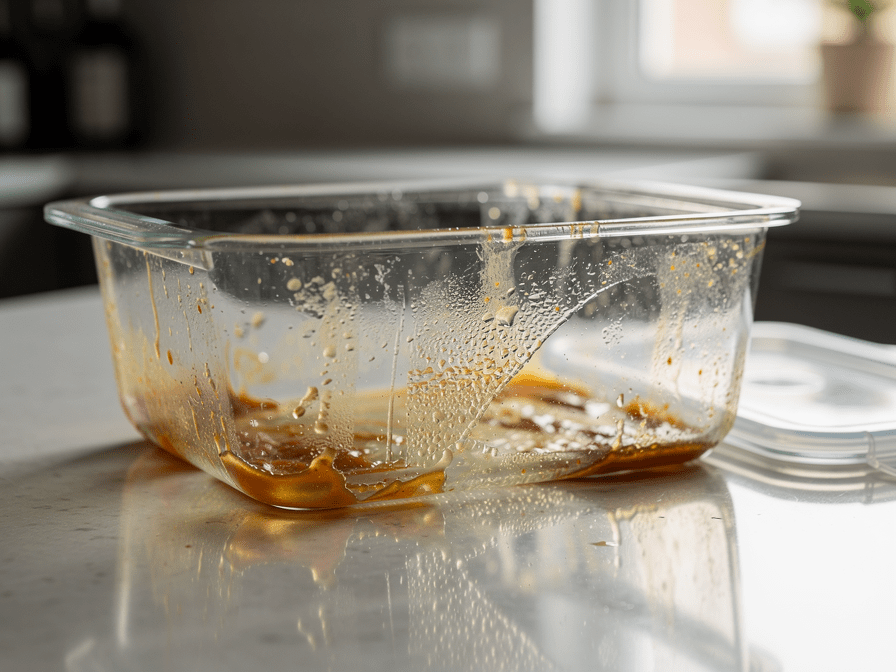

Fill the container with warm water and two tablespoons of baking soda. Seal the lid. Leave it for 15 to 30 minutes. Rinse and air dry upside down. For stubborn smells like fish or curry, use undiluted white vinegar instead. Leave for an hour. Rinse with hot water. A few hours of direct sunlight finishes the job without any chemicals.
You washed it. You soaked it. It still smells like last Tuesday's garlic shrimp.
The problem is almost never the glass. Keep reading — the actual culprit is smaller than you think and easier to fix.

Why Does My Glass Container Still Smell After Washing?
Glass containers that still smell after washing are almost always contaminated in the lid seal — not the glass itself. Silicone and rubber gaskets trap food compounds in their surface. The second cause is washing in lukewarm water. Fat-soluble odor molecules do not break down below 140°F.
Three things cause the smell to stick:
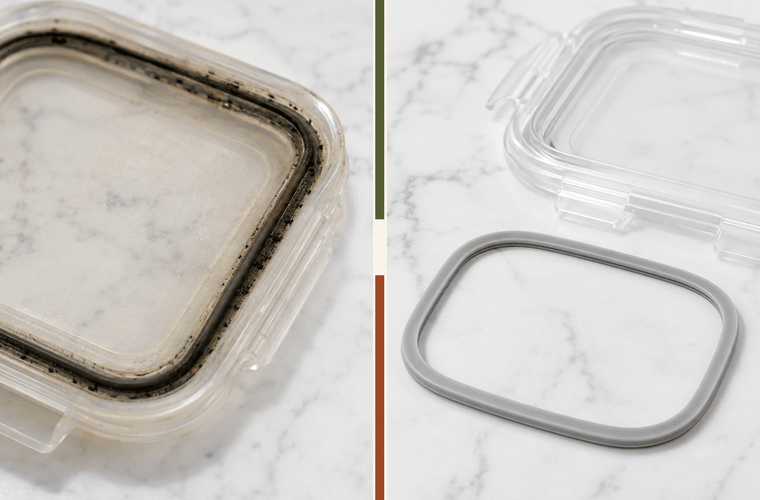
The lid gasket is the real problem. Most glass container lids have a silicone seal around the inner edge. That seal traps microscopic food particles over time. Garlic, fish, curry, and onion all contain volatile sulfur compounds. Those bond to silicone far more stubbornly than they bond to glass. A dishwasher cycle often cleans the glass completely and leaves the smell in the seal.
If the container smells fine after washing but the smell returns when you close the lid — the gasket is the cause. The fix is cleaning it directly (see the sections below).
Water temperature matters more than you think. Hot water breaks down fat-soluble odor compounds. Lukewarm water does not. Wash glass containers in the hottest water your sink produces. Run the dishwasher on the sanitize or high-heat cycle.
Sealing the container while still wet. Closing a glass container with moisture inside traps humidity. Bacteria grow on any remaining food residue. The smell compounds quickly. Always air dry fully before closing.

Does Borosilicate Glass Absorb Odors Like Plastic Does?
No. Borosilicate glass does not absorb food odors. Glass is non-porous. There are no microscopic surface gaps for odor molecules to enter. Plastic is different — food compounds physically diffuse into the polymer over time and cannot be fully washed out.
A glass container that smells has contamination on the surface or in the seal. Not inside the material. Which means it can be cleaned completely, every time.
This is why Razab builds all containers from borosilicate glass rather than soda-lime glass or plastic. The non-porous surface resets with a proper clean. If you are comparing options, our glass food containers with lids that are leak-proof and spill-proof due to their airtight lids are designed with silicone gaskets you can remove and clean separately.
Fun fact: borosilicate glass was originally developed in the 1880s for laboratory equipment, where odor contamination between experiments was a real problem. The same non-porous property that made it ideal for labs makes it the right call for your fridge.
How Do You Get Curry Smell Out of Glass Containers?
To get curry smell out of glass containers, coat the inside with a thick baking soda and water paste. Seal the lid. Leave overnight. For the gasket, remove it from the lid, soak in undiluted white vinegar for 30 minutes, then air dry in sunlight. UV light breaks down turmeric-based odor compounds faster than any cleaning agent.
Curry is one of the most persistent food smells. Turmeric and cumin contain fat-soluble compounds that cling to surfaces. Here is the full method:
-
Remove the lid gasket if it is detachable. Most silicone gaskets pull out of the lid groove with a finger.
-
Make a paste — two parts baking soda, one part water. Coat the inside of the container.
-
Seal the lid. Leave overnight. Baking soda neutralizes volatile compounds rather than masking them.
-
For the gasket: soak in undiluted white vinegar for 30 to 60 minutes. Vinegar works better on silicone than baking soda does.
-
Rinse everything. Air dry in direct sunlight for 2 to 4 hours.
-
Reassemble only when completely dry.
If the smell persists after this, the gasket may need replacing. A gasket that has been through hundreds of dishwasher cycles does eventually degrade past the point where cleaning helps.

How Do You Get Fish Smell Out of Glass Food Containers?
To get fish smell out of glass food containers, mix one part white vinegar with three parts hot water. Fill the container. Seal the lid. Leave for one to three hours. Rinse with hot water. Air dry uncovered. The acetic acid in vinegar neutralizes trimethylamine — the compound responsible for fishy odor. This is not masking the smell. It ends the chemical reaction causing it.
Step by step:
-
Mix one part white vinegar with three parts hot water. Use the hottest tap water you have.
-
Fill the container. Add a splash of vinegar to the lid and seal.
-
Leave for at least one hour. Up to three hours for strong smell.
-
Pour out. Rinse with hot water.
-
If smell remains: add dry baking soda to the empty container. Close the lid. Leave overnight.
-
Rinse and air dry fully before using.
Do not substitute lemon juice for vinegar. The acidity is lower and it leaves residue in the lid seal over time.
Quick Tip: The Newspaper Trick
For containers stored in a cabinet that develop a stale smell, crumple a sheet of newspaper inside and seal for 24 hours. The activated carbon in newspaper ink absorbs ambient odors. It sounds odd. It works.

My Glass Container Smells Like Garlic — How Do I Fix It?
To remove garlic smell from a glass container, fill it with hot water and two tablespoons of baking soda. Seal. Leave for at least two hours. Soak the gasket separately in undiluted white vinegar. Allicin — the compound behind garlic's sharp smell — responds better to baking soda on glass surfaces and to vinegar on silicone gaskets.
Garlic is stubborn because allicin bonds readily to surfaces and breaks down slowly on its own. On glass, it is only on the surface. The same method as curry removal works well.
One thing most people miss: check the underside of the lid where the gasket sits in its groove. Garlic oils collect in that channel and survive multiple wash cycles. Use a thin bottle brush or cotton swab to clean the groove directly.

What Are the Best Methods for Removing Smell from Glass Containers?
Different odors respond to different treatments. Here is a reference table for the most common food smells and the fastest method for each:
|
Smell Type |
Best First Method |
How Long |
Follow-up If Needed |
|
Curry / turmeric |
Baking soda paste overnight + gasket soak in vinegar |
8-12 hours |
Sunlight, 2-4 hours |
|
Fish / seafood |
Vinegar + hot water solution, 1-3 hours |
1-3 hours |
Baking soda overnight |
|
Garlic / onion |
Baking soda + hot water, sealed |
2-4 hours |
Vinegar soak on gasket |
|
General mustiness |
Newspaper in sealed container |
24 hours |
Baking soda rinse |
|
Tomato / acidic food |
Hot water wash + baking soda |
1-2 hours |
Sunlight dry |
|
General stale smell |
Sunlight exposure, lid off |
2-4 hours |
Baking soda if persistent |
Does Sunlight Actually Remove Food Smells from Glass?
Yes — and it works better than most people expect. UV light breaks down volatile organic compounds. These are the molecules responsible for most food odors. Leave a clean, open glass container in direct sunlight for 2 to 4 hours. The effect is noticeable.
This works best as a finishing step after washing — not as a replacement for it. Lay the removed gasket flat in sunlight alongside the container for best results.
Can you use activated charcoal?
Yes. Place one or two activated charcoal tablets inside, seal the lid, and leave for 24 to 48 hours. Activated charcoal adsorbs odor molecules from the air inside. Wash the container first — charcoal handles residual smell, not surface contamination.

How Do You Sanitize Glass Jars and Containers Properly?
To sanitize glass jars and containers, wash with hot soapy water first. Then either submerge in boiling water for 10 minutes, or use a diluted bleach solution (one tablespoon of unscented bleach per gallon of water, leave two minutes, rinse thoroughly). For everyday containers, the dishwasher sanitize cycle achieves the same result.
Sanitizing and deodorizing are two separate tasks. Deodorize first. Sanitize second. Odor compounds on the surface can interfere with the sanitization step if they are still present.
Borosilicate glass handles boiling water without cracking. Standard soda-lime glass is less reliable under thermal shock. All Razab containers use borosilicate glass, so boiling is safe. Remove lids before any boiling step and sanitize them separately in hot soapy water.
Is Glass Smell-Proof for Food Storage?
The glass itself is completely smell-proof in both directions. Odors cannot pass through the glass walls. Food compounds cannot absorb into the material. The lid seal is the only non-glass component and the only point where smell can transfer. A well-maintained silicone gasket on a properly sealed container is the closest thing to smell-proof storage available in a home kitchen.
This is why people switch from plastic after years of stained containers. Plastic absorbs odors into the material over time. You can wash a plastic container a hundred times and it will still carry the curry it held two years ago. Glass resets completely.

FAQs
Why does my glass container still smell after washing?
The most likely cause is the lid gasket. Silicone gaskets trap odor compounds from strong foods like garlic, fish, and curry. A standard dishwasher cycle often does not clean them fully. Remove the gasket, soak in white vinegar for 30 minutes, rinse, and air dry. Also check that you are washing in hot water — lukewarm water does not break down fat-soluble odor molecules.
Do glass containers hold odors like plastic?
No. Glass is non-porous, so food odor compounds cannot enter the material itself. Plastic is porous at the molecular level — volatile compounds from food physically absorb into the polymer over time. Glass that smells after washing has surface contamination or a dirty lid seal. Both can be fully cleaned. Plastic that smells has absorbed the odor permanently.
Why does borosilicate glass not absorb food smell?
Borosilicate glass is inert and non-porous. Its surface has no microscopic gaps for odor molecules to enter. Food odors — allicin in garlic, trimethylamine in fish, curcumin derivatives in turmeric — can sit on the surface of glass but cannot penetrate it. A thorough clean removes smell completely every time.
Is glass smell-proof for food storage?
The glass itself is completely smell-proof. Odors cannot pass through the walls and food compounds cannot absorb into the material. The only weak point is the lid seal. Clean the gasket separately, air dry in sunlight, and the container effectively resets between uses.
How do you sanitize glass jars at home?
Wash first with hot soapy water to remove food residue. Then submerge in boiling water for 10 minutes, use a diluted bleach solution for 2 minutes followed by a thorough rinse, or run on the dishwasher sanitize cycle. Always clean the jar before sanitizing — sanitizing a container with food residue still inside will not be fully effective.
The Right Container Makes This Easier
The methods above work on any glass container. A few design details make the whole process faster: a removable gasket you can clean separately, borosilicate glass that handles boiling and high-heat dishwasher cycles, and a lid that seals airtight.
If your current containers are past saving, Razab's borosilicate glass food storage containers are built with all three. Trusted by 50,000+ reviewers who have run them through exactly the kind of cooking described above.
About the Author
The Razab Product Research Team built this guide after testing our borosilicate glass containers against high-sulfur and fat-soluble food compounds specifically — garlic, fish, and curry — to confirm that each cleaning method above produces complete odor removal. We build containers for real kitchens. That means testing what actually matters.

Conversation
Join the discussion