5 min read | Published: August 21, 2026

|
Quick Answer Square and rectangular glass containers maximize fridge shelf space by up to 25 percent compared to round containers of the same volume. Round containers leave dead corner space at every junction point — space that no food or container can fill. For weekly meal prep where 6 to 10 containers share one fridge zone, square and rectangular shapes are more practical. Round containers earn their place for soups, stews, and single-bowl meals where corner-free scooping matters more than shelf efficiency. |
Container shape affects three things that matter every meal prep week: how many containers fit on a fridge shelf, how well the food portions fit inside, and how easy the container is to wash. Most people choose shape based on what looks good in the store photo. The better method is matching shape to the specific meal type and the actual geometry of the fridge shelf.
Razab glass meal prep containers come in round, square, and rectangular profiles — each with a specific use case. This guide covers all three with the real-world scenarios where each one outperforms the others.

Shape vs Shelf Space: The Dead Corner Problem
|
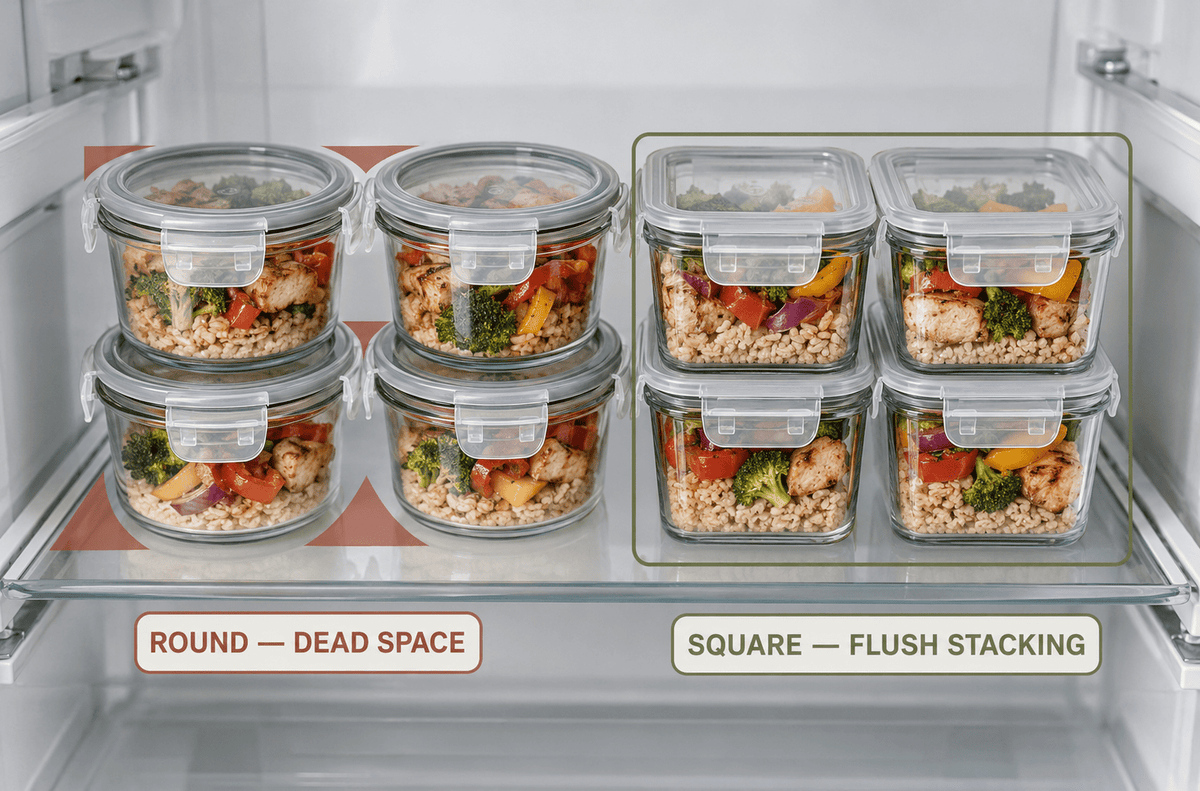
Square and rectangular glass containers stack flush against fridge back walls and against each other with zero wasted space at any junction. Round containers leave four dead corner zones wherever three or four containers meet — gaps that cannot hold food and cannot be used for storage. In a standard 24-inch deep fridge shelf holding 8 meal prep containers, switching from round to square recovers approximately 2 to 3 inches of usable shelf depth and space for 1 to 2 additional containers. |
The geometry is straightforward. A circle inscribed inside a square grid occupies approximately 78 percent of that grid's area. The remaining 22 percent is dead corner space — wasted at every junction point between round containers, between a round container and the fridge wall, and between a round container and the shelf divider. Over 8 to 10 containers spread across a full fridge shelf, those dead zones accumulate into enough space for 2 additional containers that cannot fit because of the shape.
Square containers eliminate this entirely. Each flat side sits flush against the adjacent container's flat side. Zero dead space at any junction. The shelf fills to near 100 percent utilization. For a household doing a full Sunday meal prep with 6 to 8 containers going into the fridge simultaneously, this space efficiency is the difference between a workable system and an overfull fridge that forces double-stacking.
Fridge organization with glass food storage shows the before-and-after of switching from a mixed container system to matched square glass containers — including the shelf zone assignments that make individual containers accessible without moving the entire stack.
Portion Control and Food Types: Which Shape Fits Which Meal
Round Glass Containers — Best For Soups, Stews, and Single-Bowl Meals
Round containers have one genuine advantage: no corners. When scooping a thick soup, curry, or stew from a round container, a ladle or spoon reaches every part of the base without navigating 90-degree angles. Corners trap the last tablespoon of sauce that a round base releases cleanly in one scoop.
Round containers also wash more easily for liquid-heavy foods. There are no interior corners where sauce can accumulate and dry. For a household that regularly stores soups, smoothie bowls, or liquid-base sauces and eats directly from the container, a small set of round glass containers alongside a primary square system covers both scenarios without compromise.
Where round containers fall short: structured meals with multiple components. A protein portion, a grain serving, and a vegetable side fit a rectangular container naturally — each component sits side by side. In a round container, the same components pile asymmetrically on a curved base that was not designed for flat portions.
Square Glass Containers — Best For Structured Meal Prep Portions
Square containers are the workhorse of weekly meal prep. They stack flush, they fit the geometry of most prepared foods, and they portion cleanly. A grilled chicken breast, 3/4 cup of cooked rice, and a serving of roasted vegetables fit a square container the way they were plated — flat, organized, side by side.
Square containers also work well for batch storage where the full batch goes into one container before portioning into individual sizes. The flat base and flat lid create a stable two-layer stacking column — four square containers with flat lids stack in a stable 2x2 arrangement that fits the geometry of a standard fridge shelf without sliding. High protein meal prep with glass containers shows this two-stage system — batch container for the cook, square containers for daily portions.
Rectangular Glass Containers — Best For Larger Portions and Batch Cooking
Rectangular containers match the natural shape of most oven-cooked and baked foods. Lasagna, sheet pan salmon, baked chicken thighs, roasted vegetables — all of these come out of the oven as rectangular portions. Storing them in rectangular glass containers preserves the portion shape without reshaping or trimming.
Rectangular containers also offer the largest capacity per shelf footprint. For batch cooking for a family — a full lasagna, a large pot of chili, or a sheet pan of roasted chicken thighs — rectangular glass containers hold the most food in the least shelf space. Razab 1860ml rectangular glass container and the 2260ml rectangular glass container are the correct sizes for family-batch storage.
Master Comparison Table: Round vs Square vs Rectangular
|
Container Shape |
Fridge Space Efficiency |
Best Food Types |
Cleaning Ease |
Best Razab Size |
|
Round |
Low — dead corner space at junctions |
Soups, stews, curries, smoothie bowls, single-scoop meals |
High — no corners for sauce to trap |
800ml round for soup portions |
|
Square |
High — flat sides stack flush |
Structured meals, grain bowls, protein + carb + veg, snack portions |
Medium — corners need a brush |
800ml square for single meals, 1040ml square for saucy meals |
|
Rectangular |
Highest — maximum footprint per volume |
Lasagna, sheet pan meals, large batch portions, casseroles |
Medium — long corners need thorough rinse |
1860ml and 2260ml for family batches, 3900ml for extra-large |
3 Stacking Mistakes That Waste Fridge Space
Mistake 1 — Mixing Shapes in One Fridge Zone
A round container placed next to a square container creates dead space on both sides. The round container's curved surface does not sit flush against the square container's flat surface — the gap between them is unusable. Dedicate one fridge shelf to one shape. Square containers for the meal prep zone, round containers for the soup zone. Mixed shapes on the same shelf guarantee wasted space regardless of how carefully you arrange them.
Mistake 2 — Stacking Containers With Lids Snapped On When Empty
Empty glass containers stored with lids fully snapped on waste the interior volume of every container below. Empty containers nested inside each other reduce their combined storage height by 60 to 70 percent. A stack of 5 nested 800ml square containers takes up the same cabinet space as 2 containers stored lid-on. Store lids in a vertical organizer beside the containers and nest empty containers inside each other — this single change recovers significant cabinet space in most kitchens.
Mistake 3 — Using Large Rectangular Containers for Single Portions
A 1860ml rectangular container storing a single 400-calorie lunch portion has 75 percent of its volume as wasted headspace. Excess headspace above food accelerates moisture loss and quality decline over the prep week. Match container size to portion: 800ml for single dry meals, 1040ml for single saucy meals. Save the large rectangular containers for their intended purpose — family-batch storage and multi-day portions. How long meal prep lasts in glass containers shows how proper sizing affects freshness duration across a 5-day prep week.
Why Shape Matters More in Glass Than Plastic
The shape efficiency argument applies equally to glass and plastic containers. But glass has two properties that make the shape decision more consequential in practice. First, glass containers are heavier than plastic — an overfull glass container fridge is harder to reorganize than an overfull plastic fridge because each container takes more effort to move. Getting the shape right the first time matters more.
Second, glass containers last a decade or more without replacement. A plastic container shape that turns out to be wrong for your workflow gets replaced within 18 to 24 months when the plastic stains or warps. A glass container shape that is wrong for your workflow stays wrong for years. NIH research on phthalate exposure documents why replacing plastic food containers with glass is a health improvement — which makes choosing the right glass shape the one decision worth getting right the first time. Glass vs plastic food storage has the full material comparison.
|
Choosing Your Shape — 3 Questions
|
Frequently Asked Questions
Do square or round glass containers hold more volume at the same size?
At the same external footprint, square glass containers hold approximately 22 percent more volume than round containers. A square base uses 100 percent of its grid area. A round base inscribed in the same grid uses approximately 78 percent. The extra base area in a square container translates directly to greater volume at the same container height. Razab glass meal prep containers shows the exact volume for every available size.
Which glass container shape is easiest to clean?
Round glass containers are easiest to clean for liquid-heavy foods — no corners for sauce to accumulate and dry. Square and rectangular containers require a corner brush or corner sponge to reach 90-degree interior angles. For most meal prep users, the space efficiency of square containers outweighs this minor extra cleaning step. Borosilicate glass releases food residue more easily than plastic regardless of shape — the non-porous surface does not grip dried sauce the way a scratched plastic surface does.
Can you mix round and square glass containers in the same fridge?
You can, but efficiency drops significantly. Mixed shapes on the same shelf cannot tile together — the dead corner space between round and square containers means the shelf holds fewer containers than a matched-shape system. The practical solution: dedicate specific fridge zones to specific shapes. Soup zone: round. Meal prep zone: square or rectangular.
Are rectangular glass containers dishwasher safe?
Yes — all Razab glass containers including rectangular sizes are dishwasher safe. The glass body goes on the bottom rack. Lids and silicone gaskets go on the top rack. Remove the silicone gasket from the lid channel before dishwasher cycles for thorough cleaning of both components. Glass containers in the dishwasher has the complete protocol including gasket care and lid placement.
Which glass container shape is best for freezer meal prep?
Square and rectangular glass containers are better for freezer meal prep for the same reason they are better for fridge storage: they stack flush and use freezer space efficiently. Round containers leave dead corner space in the freezer exactly as they do in the fridge. Fill all shapes to 75 percent maximum when freezing liquid-containing foods. Glass containers in the freezer covers the headspace rules and the correct lid protocol for freezing.
Square glass containers are the practical choice for most weekly meal prep — they use fridge and freezer space efficiently, match the geometry of most prepared foods, and stack stably in matched columns. Rectangular containers handle large batches and family portions. Round containers earn their place for soups and curries where corner-free scooping matters. Razab glass meal prep containers are available in all three shapes — the 16-piece set covers single-portion weekly prep and the 30-piece set covers a full household system.
|
About the Author Produced by the Razab Kitchen Research Team. We test glass container geometry across fridge configurations, meal types, and storage scenarios to confirm which shapes produce the best real-world results. Razab is a woman-owned brand, designed in New York and trusted by over 1 million US families since 2017. Published: August 21, 2026 |
Conversation
Join the discussion