6 min read | Published: August 24, 2026

|
Quick Answer No plastic food container — including BPA-free plastic tupperware, plastic bags, and ketchup containers — is truly safe for food storage. All plastic food contact surfaces leach chemical compounds into food. Heat, acidity, and time all accelerate the process. BPA-free plastic replaced one harmful compound with structurally identical alternatives (BPS and BPF) that NIH research shows carry the same endocrine disruption risks. The only food storage material that does not leach, does not stain, and does not react with food at any temperature or pH is borosilicate glass. |
The orange ring inside a plastic container after storing tomato sauce. The permanent ketchup smell that survives three rounds of dishwashing. The cloudy film on plastic tupperware after a year of use. These are not cosmetic problems. They are the visible evidence of a chemical relationship between plastic and food that is happening in one direction the whole time you are using that container.
Plastic is not an inert material. It is a polymer — a chain of chemical compounds held together by bonds that food acids, heat, and mechanical wear all attack over time. Every scratch, every microwave session, every acidic meal stored overnight is a small degradation event that transfers plastic-derived compounds into the food the container was supposed to be protecting.

The BPA-Free Myth: Why Plastic Tupperware Is Still Bad for You
|
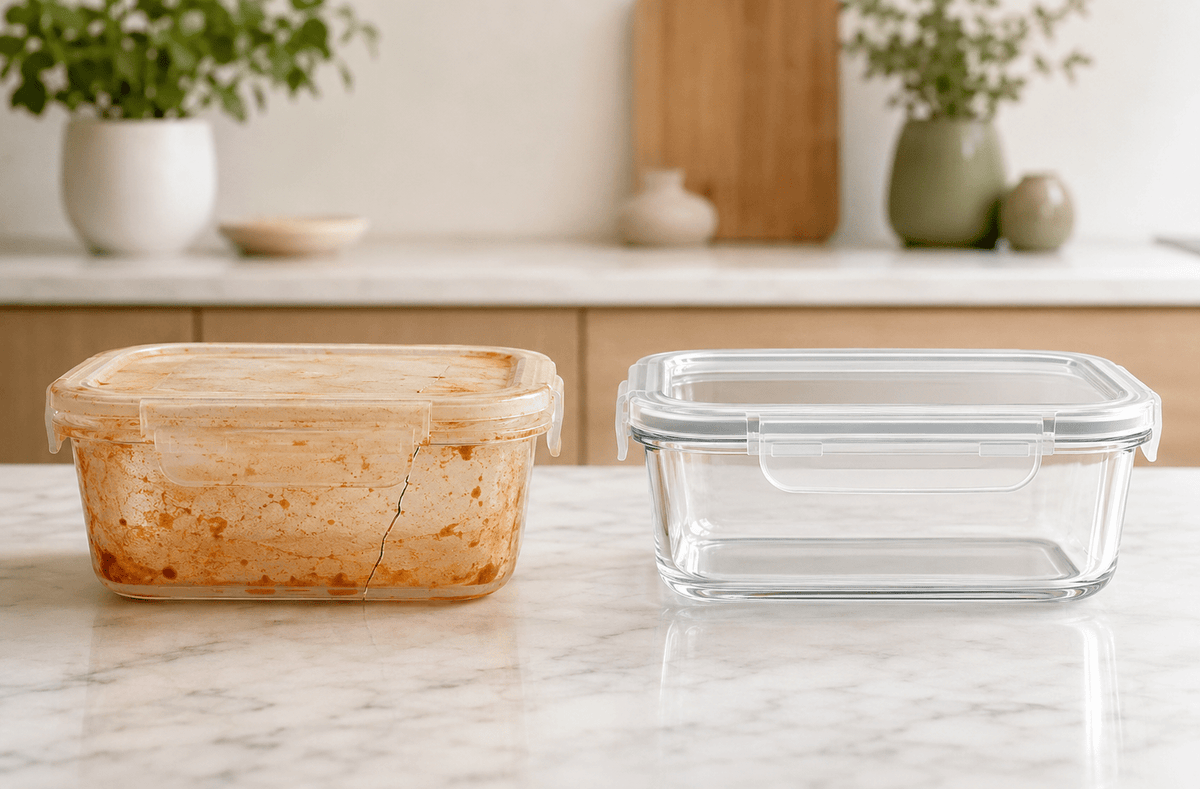
BPA-free plastic tupperware is not safe — it is BPA-specific. Manufacturers replaced bisphenol A with bisphenol S (BPS) and bisphenol F (BPF) — structurally similar compounds that NIH-published research shows have the same endocrine disruption mechanism at comparable ALT text: Orange-stained cracked plastic container beside a clean Razab glass food storage container with lid. exposure levels. Removing BPA from plastic did not make plastic food containers safe. It replaced one documented endocrine disruptor with two less-studied ones that behave the same way in the body. |
The endocrine disruption mechanism is worth understanding because it explains why no plastic formulation produces a truly safe food storage container. Bisphenol compounds mimic estrogen at hormone receptors. They do not need to be present in large quantities to cause disruption — they operate at parts per billion. The exposure pathway from food storage containers is continuous: every meal stored in plastic, every plastic container used in a microwave, every acidic food like ketchup or tomato sauce left in a plastic container overnight contributes to cumulative bisphenol exposure.
NIH research on bisphenol exposure documents the hormonal disruption pathway for BPA, BPS, and BPF. The research confirms that the substitution of BPA with BPS and BPF in food-contact plastics did not resolve the safety concern — it shifted it to compounds with shorter research histories and similar mechanisms. The safest response to a BPA-free label on plastic food storage containers is skepticism, not reassurance.
Why Ketchup and Acidic Foods Make Plastic Containers Worse
|
Storing ketchup, tomato sauce, citrus-based marinades, or any acidic food in plastic containers — even briefly — accelerates chemical leaching. Acid attacks plastic polymer bonds through a process called micro-etching, creating invisible surface channels that trap food pigments (causing permanent orange staining), absorb odors permanently, and dramatically increase the rate of compound migration from plastic into food. The orange ketchup stain inside a plastic container is evidence that the plastic surface has already been chemically compromised. |
The pH of common kitchen foods tells the story clearly. Ketchup sits at approximately pH 3.9. Tomato sauce is pH 4.0 to 4.6. Citrus marinades reach pH 2.0 to 3.0. Vinegar dressings reach pH 2.4. Every one of these foods has enough acidity to chemically attack polypropylene plastic surfaces on contact. The attack is not dramatic — it happens at the molecular level, invisibly, every time the food touches the plastic. Over repeated use, the surface develops micro-pits that trap pigments and bacteria, and the rate of compound migration into the food increases with each use cycle.
|
Food Type |
pH Level |
Plastic Container Effect |
Glass Container Result |
|
Ketchup |
3.9 |
Permanent orange staining. Compound migration into ketchup during storage. |
Zero staining. Washes completely clean every time. |
|
Tomato sauce / marinara |
4.0 to 4.6 |
Lycopene penetrates plastic surface. Permanent discoloration. Odor absorption. |
No penetration. No staining. No odor retention. |
|
Citrus marinade (lemon/lime) |
2.0 to 3.0 |
Severe surface etching. Plastic becomes cloudy and pitted within weeks. |
Completely inert. No surface changes after years of use. |
|
Vinegar dressing / pickle brine |
2.4 |
Permanent vinegar odor absorbed into plastic walls. Surface degradation. |
Odor gone after one wash. Surface unchanged. |
|
Kimchi |
3.5 to 4.0 |
Garlic and chili compounds bind permanently to plastic. Container unusable for other foods. |
No odor absorption. Same container stores overnight oats next week. |
|
Salsa / pico de gallo |
3.5 to 4.5 |
Tomato and lime both attack plastic. Combined staining and odor. |
Zero interaction. Washes clean. |
Are Plastic Bags Safe for Food Storage? No — Here Is Why
|
Plastic bags are not safe food storage — they are thinner than rigid containers, which means more plastic-to-food surface contact per gram of food, and the polyethylene film used in most zipper bags is not manufactured to the same food-contact standards as rigid polypropylene. Heating food in plastic bags, freezing fatty or acidic foods in plastic bags, and storing marinating meat in plastic bags all create direct food-plastic contact under conditions that maximize compound migration. |
The thin film of a plastic bag creates more contact area per gram of food than a rigid container. A chicken breast marinating in a plastic zipper bag is surrounded by plastic on all sides with the plastic pressing directly against every surface of the meat. Fat-soluble compounds from the plastic migrate into the fatty meat tissue with every hour of contact. The same chicken marinating in a glass container with a lid has plastic contact only at the lid — and Razab lids are designed to minimize food contact with the plastic components.
FDA microplastics research 2026 documents the ongoing federal investigation into microplastic migration from food packaging into the food supply. Plastic bags are a primary focus of this research because of the thin-film, high-contact-area profile. Microplastics are now found in human blood, lung tissue, and breast milk — the food storage and packaging system is a documented exposure pathway. Switching from plastic bags to glass food storage containers with lids removes this pathway entirely for home food storage.
Can You Freeze Food in Plastic Containers? Why Glass Is Better
|
Freezing food in plastic containers does not stop chemical leaching — it slows it. Cold temperatures reduce migration rates but do not eliminate them. Plastic also becomes brittle below 32°F and can develop micro-cracks from freezer temperature fluctuations. These cracks increase the plastic surface area in contact with food during the thaw cycle, when temperatures rise and migration rates increase again. Glass freezer containers have none of these failure modes. |
The freeze-thaw cycle is the specific scenario where plastic container degradation accelerates over time. Every freeze-thaw cycle stresses the plastic polymer structure — the material contracts when cold and expands when warm. Over 20 to 30 freeze-thaw cycles (a typical weekly meal prep household reaches this within 6 months), micro-cracks develop throughout the container body. The container that looked fine when new has become a degraded plastic surface with dramatically higher compound migration rates.
Borosilicate glass handles freeze-thaw cycles without any structural change. The material does not become brittle at freezer temperatures and does not develop micro-cracks from thermal cycling. A glass freezer container used for 5 years has the same surface quality as day one. Glass containers in the freezer covers the correct headspace and lid protocol for every food type — the glass handles the temperature, the protocol handles the expansion.
Why Glass Storage Containers With Lids Are the Only Real Answer
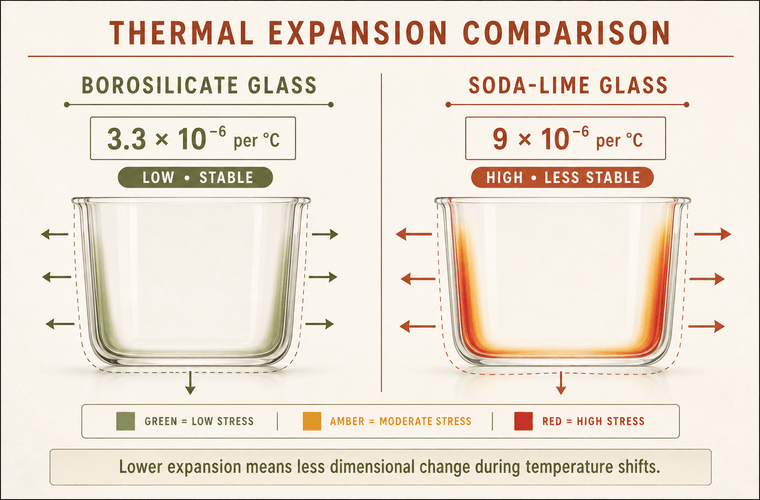
Borosilicate glass is chemically inert. Not mostly inert. Not inert except for acidic foods. Not inert at room temperature. Completely inert at every temperature, every pH level, and every food type that a home kitchen encounters. Silicon dioxide and boron trioxide — the primary components of borosilicate glass — do not have polymer bonds for acid to attack, do not contain bisphenol compounds to leach, and do not develop surface micro-pitting from mechanical wear.
The same glass container that stores tomato sauce with ketchup base on Sunday stores overnight oats on Monday and goes into the microwave on Tuesday and comes out of the freezer on Wednesday — with no chemical interaction at any step and no odor or stain from any previous use. This is what genuine food-safe storage looks like. Non-toxic food storage covers every material comparison across glass, plastic, silicone, and stainless steel.
|
Every Plastic Problem — Glass Solution
|
Frequently Asked Questions
Is it safe to store food in plastic containers?
No plastic food storage container is truly safe. All plastic food contact surfaces leach chemical compounds into food — the rate varies with temperature, food acidity, and container age, but the process is continuous regardless of BPA-free labeling. NIH research on bisphenol compounds documents that BPS and BPF — the BPA replacements in current plastic containers — have the same endocrine disruption mechanism. Borosilicate glass storage containers with lids are the only food storage material that is genuinely chemically inert at every temperature and pH.
Is plastic tupperware bad for you?
Yes. Plastic tupperware leaches bisphenol compounds (BPA, BPS, or BPF depending on the product) into food at a rate that increases with heat, acidity, and container age. BPA-free labeling means the product does not contain bisphenol A — it does not mean the product is free of endocrine-disrupting compounds. NIH research shows BPS and BPF carry the same hormonal disruption risks as BPA. The only tupperware that does not leach any compounds into food is glass tupperware — borosilicate glass containers with locking lids.
Are plastic bags safe for food storage?
No. Plastic bags create direct contact between thin plastic film and food on all surfaces — more contact area per gram of food than any rigid container. Fatty foods, acidic foods, and marinating proteins stored in plastic bags all experience higher compound migration than the same foods in glass. FDA microplastics research identifies food packaging as a primary pathway for microplastic exposure. Glass containers with lids remove this pathway entirely.
Can you freeze food in plastic containers?
Freezing slows but does not stop chemical leaching from plastic. Plastic also becomes brittle at freezer temperatures and develops micro-cracks from repeated freeze-thaw cycles — increasing plastic surface area in contact with food and compound migration rates over time. Glass freezer containers handle freeze-thaw cycles without any structural degradation and produce zero chemical migration at any temperature.
Why does ketchup stain plastic containers?
Ketchup is acidic enough (pH 3.9) to chemically soften the plastic surface through micro-etching. Once softened, lycopene — the red-orange pigment in tomatoes — penetrates the plastic and binds permanently. The stain is evidence that the plastic surface has been chemically compromised and that compound migration from plastic into the ketchup has occurred simultaneously. Glass does not stain from ketchup because glass is chemically inert to food acids at any concentration.
What are the safest food storage containers with lids?
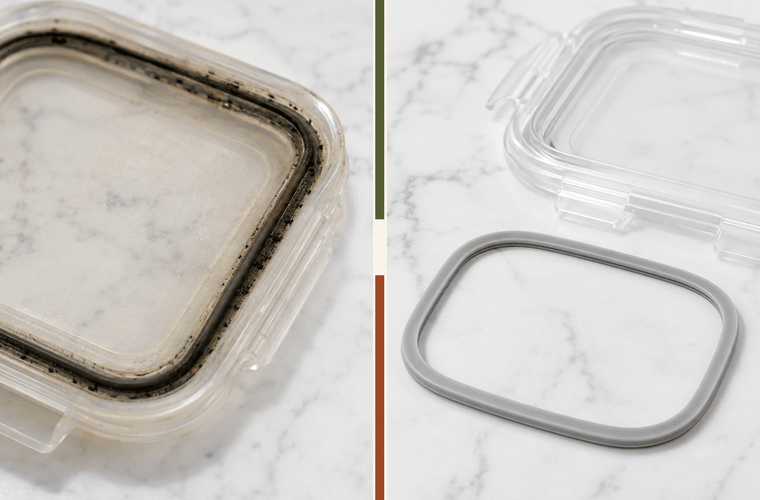
Borosilicate glass storage containers with four-tab locking lids and silicone gaskets. Glass is the only food storage material that is completely chemically inert — it does not leach, does not stain, does not absorb odors, and does not degrade from heat, acidity, or repeated use. Razab glass food storage containers are available from small snack containers to large batch-cooking sizes, all with food-grade silicone gasket lids.
Plastic food containers — whether tupperware, ketchup containers, or plastic bags — all leach compounds into food. BPA-free labeling shifts the compound but not the mechanism. Heat, acidity, time, and mechanical wear all accelerate the process. Razab glass food storage containers with lids are chemically inert at every temperature and pH — the one food storage material that eliminates the leaching problem entirely rather than managing it. The 16-piece glass set covers the most common storage container sizes for a complete switch from plastic, and the 35-piece set covers an entire household system.
|
About the Author Produced by the Razab Kitchen Research Team. We test glass container performance against every common food storage material — plastic, silicone, and stainless steel — across acidic foods, heat exposure, and long-term storage. Razab is a woman-owned brand, designed in New York and trusted by over 1 million US families since 2017. Published: August 24, 2026 |
Conversation
Join the discussion