8 min read | Published: August 21, 2026

|
Quick Answer Glass food storage containers with locking lids are oven safe to 450°F, microwave safe, freezer safe, and dishwasher safe — all four in one container. Borosilicate glass is the correct material. Tempered glass handles freezer and microwave use but not oven. Standard soda-lime glass is none of the above. Sizes range from 370ml snack containers to 6,500ml extra-large glass containers for bulk storage. Stackable glass containers with matching lids save 40 to 60 percent more shelf and fridge space than mixed container systems. Glass does not absorb food odors, stain from tomato sauce, or leach chemicals — the three reasons most households switch from plastic to glass. |
Glass food storage containers outlast plastic by a decade or more and do not absorb the tomato sauce smell that makes plastic containers smell like last week's dinner. They do not stain yellow from turmeric or curry. They do not leach BPA, phthalates, or other chemical compounds into food — because glass is chemically inert at every temperature a home kitchen reaches. The performance difference over time is significant. The container you put in the dishwasher today will look the same in five years. Plastic will not.
This guide covers every category of glass food storage container — from small glass snack containers to extra-large glass containers for bulk storage, from stackable glass meal prep containers to glass containers with glass lids — with the exact product specifications and the complete kitchen safety record for each.

What Makes Glass Food Storage Containers Better Than Plastic?
|
Glass food storage containers are chemically inert — they do not absorb food compounds, odors, or flavors at any temperature. Plastic containers absorb fat-soluble compounds from food over time, producing permanent staining and odor transfer. Glass does neither. After 500 dishwasher cycles, a glass container looks identical to its first use. After the same cycles, most plastic containers are stained, scratched, and partially degraded. |
The non-porous advantage is the most significant practical difference. Plastic is technically BPA-free in most modern containers, but plastic itself is porous at a microscopic level — food compounds migrate into the plastic surface over repeated heating and washing cycles. This is why a plastic container used for spaghetti sauce smells like spaghetti sauce even after washing. Glass has no porosity. The tomato sauce sits on top of the glass surface. Washing removes it completely. Glass vs plastic food storage documents the material science behind this difference with testing data.
Temperature versatility is the second major advantage. A quality borosilicate glass container goes from the freezer to the oven, from the oven to the table, and from the table into the dishwasher — all without transfer. A plastic container handles exactly one of those transitions safely. For anyone who meal preps, this matters every week: cook in the glass container, freeze it, reheat it in the microwave or oven, eat from it, wash it.
|
Did You Know: The average US household replaces its plastic food storage containers every 18 to 24 months from staining, warping, and odor buildup. A quality borosilicate glass container set lasts 10 years or more under the same conditions — making the higher upfront cost significantly cheaper over the product's lifetime. |
Borosilicate Glass vs Tempered Glass vs Soda-Lime Glass — Which Is Best?
|
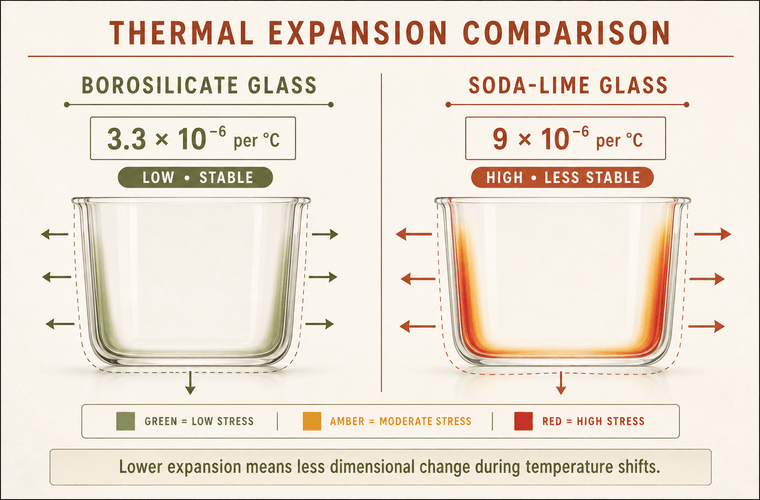
The glass type determines the container's temperature capabilities. Borosilicate glass handles the widest temperature range — oven, microwave, freezer, and sudden temperature transitions. Tempered glass handles microwave and freezer but not oven temperatures. Standard soda-lime glass is not reliably safe for any of these uses. |
|
Glass Type |
Oven Safe |
Microwave Safe |
Freezer Safe |
Dishwasher Safe |
Best For |
|
Borosilicate (Razab) |
Yes — up to 450°F |
Yes |
Yes |
Yes |
All-purpose — meal prep, freezer, oven, microwave |
|
Tempered glass |
No (some up to 350°F with caveats) |
Yes |
Yes |
Yes |
Fridge and microwave storage — not oven |
|
Soda-lime glass (standard) |
No |
Limited — risk of thermal shock |
Limited — not recommended |
Yes |
Room temperature storage only |
|
Borosilicate with glass lid |
Yes — lid must be removed for oven |
Yes |
Yes |
Yes |
All-purpose plus glass-lid freshness seal |
All Razab glass food storage containers are made from borosilicate glass rated to 450°F. The lid is always removed before oven or air fryer use — the glass body goes in the oven, the lid does not. For microwave use, the lid is removed or vented. Borosilicate vs tempered glass covers the material science in detail. Safe glass in the microwave and glass containers in the freezer cover the specific protocols for each appliance.
Glass Food Storage Container Sizes — Complete Size Guide
|
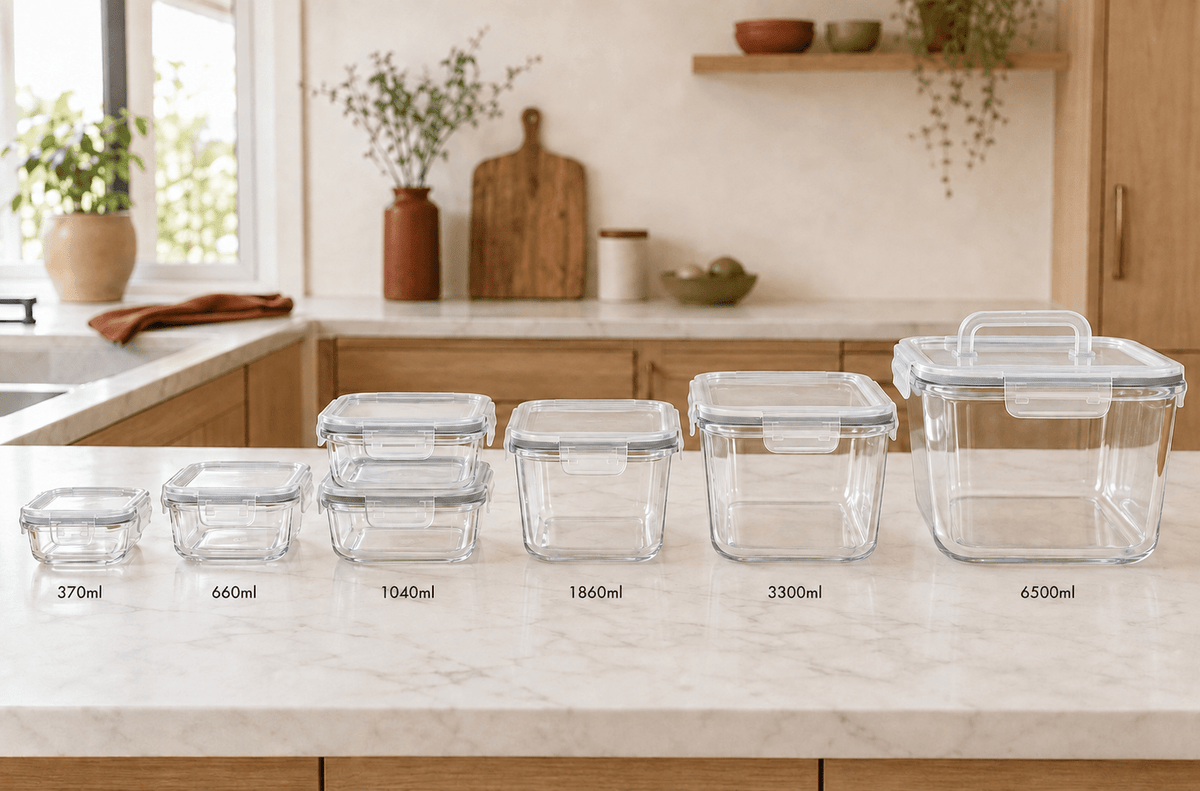
Razab glass food storage containers range from 370ml small glass snack containers to 6,500ml extra-large glass containers for bulk storage. The correct size depends on the food type and portion — not the container's physical dimensions. This table matches every common food storage scenario to the correct Razab container size. |
|
Container Size |
Common Name |
Best For |
What Fits |
|
370ml (12.5oz) |
Small glass snack container |
Snacks, dips, cut fruit, small portions |
1 cup sliced fruit, 2 tablespoons dip, small cheese portion |
|
640ml (22oz) |
Single meal — breakfast |
Overnight oats, yogurt, breakfast portions |
1 serving overnight oats with toppings |
|
800ml (27oz) |
Single meal — lunch or dinner |
Protein + dry grain, single meal without sauce |
1 chicken breast + 3/4 cup rice, dry portions |
|
1040ml (35oz) |
Single meal with sauce |
Full meal with liquid sauce, protein + grain + veg |
Full saucy meal, pasta with sauce, soup portion |
|
1200ml (40.5oz) |
Large single meal |
Two-person portion or large single meal |
Large pasta bowl, family-size soup serving |
|
1520ml (52oz) |
Batch storage |
2 to 3 person batch, cooked grain storage |
Full pot of rice, 2 to 3 meal portions together |
|
1860ml (63oz) |
Large batch |
Batch cooking for 4 |
Large casserole portion, 4-serving batch |
|
2260ml (76oz) |
Large batch — bulk |
Batch cooking for 4 to 6 |
Large soup batch, full roast chicken storage |
|
2700ml (91oz) |
Extra-large — meal prep |
Full Sunday batch, weekly grain storage |
Full pot pasta, full batch soup, 6 to 8 portions |
|
3300ml (111oz) |
Large family batch |
Family batch cooking |
Full casserole, large pot leftovers |
|
3900ml (132oz) |
Extra-large batch |
Large family or weekly prep |
Extra-large soup pot, full meal prep batch |
|
4800ml (162oz) |
Bulk glass container |
Pantry storage, large batch cooking |
Whole chicken storage, bulk dry goods |
|
6500ml (220oz) |
Huge glass container |
Extra-large bulk storage |
Full turkey carcass, extra-large batch |
The 800ml vs 1040ml decision is the most common sizing question. The difference is sauce. A dry protein and grain portion fits 800ml. The same meal with tomato or cream sauce needs 1040ml because sauce adds 100 to 150ml of liquid volume that the 800ml cannot accommodate without leaking at the lid. For meal prep containers, the 16-piece glass set covers single-meal portions and the 35-piece glass set covers a full week for multiple people.
🍎 Snacks
🍎 Snacks and Small Portions
370ml (12.5oz) glass snack container. Holds cut fruit, nuts, dips, cheese portions, and small side servings. Goes from fridge to lunch bag to dishwasher in one container.
💡 The 370ml is the most portable Razab size — fits in most lunch bags alongside a larger meal prep container.
🍱 Single Meal
🍱 Single Meal — Dry (No Sauce)
800ml (27oz) glass meal prep container. Holds one protein portion plus ¾ cup cooked grain without sauce. If adding any liquid sauce, use 1040ml instead.
💡 The 800ml and 1040ml are the two sizes that cover 90% of meal prep. The only decision is whether your meal has sauce.
🍝 Meal with Sauce
🍝 Single Meal With Sauce or Vegetables
1040ml (35oz) glass meal prep container. Sauce adds 100 to 150ml of volume that makes 800ml too small to seal cleanly. Use 1040ml for pasta with sauce, grain bowls with dressing, and any protein-and-vegetable combination.
💡 1040ml also works for overnight oats with liquid components — the extra headspace prevents spills when the oats absorb liquid overnight.
🥣 Soup or Liquid
🥣 Soup, Broth, or Liquid Portions
1040ml (35oz) for a single soup serving. 2700ml (91oz) for a full batch. Fill to 75% maximum when freezing — liquid expands 9% when frozen and a full container will crack.
💡 The 2700ml vent-lid container is specifically useful for soup — the vent allows steam escape when reheating from frozen without full lid removal.
🍲 Batch Cooking
🍲 Batch Cooking for Multiple People
1520ml (52oz) for 2 to 3 person batches. 2700ml (91oz) for full weekly prep. 3300ml or larger for family batches of 4 to 6 servings. Store the full batch in the large container, then portion into individual 800ml or 1040ml containers for daily use.
💡 Two-stage storage: batch container for the cook, individual containers for daily meals. This is the system that makes Sunday meal prep efficient through the full week.
🫙 Large / Bulk
🫙 Large and Bulk Storage
3900ml for extra-large leftovers and large family batches. 4800ml for bulk storage and whole poultry. 6500ml for the largest batches and pantry dry goods. All Razab large glass containers are oven safe to 450°F and dishwasher safe.
💡 The 6500ml with handle is designed for lifting — the handle makes a full heavy container manageable for moving from counter to fridge.
Stackable Glass Food Storage Containers — Why Matching Sets Matter
|
Stackable glass containers with matching lids stack stably only when all containers share the same footprint dimensions. Mixed container systems — different brands, different sizes, different lid shapes — do not stack reliably. A matched set of glass food storage containers converts the same fridge or pantry space into organized, stable stacks that use vertical space instead of spreading across the shelf. |
The difference between stackable glass containers and non-stackable glass containers is lid design and container base dimensions. Square and rectangular containers stack reliably because flat bases and flat lids create a stable platform. Round containers have a natural tendency to shift under the weight of containers stacked above them. All Razab glass food storage containers use square or rectangular profiles specifically for stacking stability.
The practical space saving from switching to a matched stackable system is 40 to 60 percent of fridge shelf space. A standard fridge shelf holds 3 to 4 unsorted mixed containers in a single layer. The same shelf with matched stackable glass containers holds 9 to 12 containers in stable two-layer stacks. Fridge organization with glass food storage shows the before-and-after of this conversion with specific placement by food type.
Large Glass Food Storage Containers — What They Are Actually For
|
Large glass containers — 2700ml and above — serve a different purpose than standard meal prep sizes. They are batch storage containers: the vessel that holds the full cooked batch before portioning into individual containers, the pantry storage for bulk dry goods, or the refrigerator container for a week's worth of cooked grain or protein. |
A common mistake: buying large glass containers expecting them to work as individual meal prep containers. A 4800ml glass container holding a single meal is using 80 percent of the container as headspace — excess air that reduces freshness. Large glass containers are sized for batch storage and should be filled to 80 to 90 percent capacity to work correctly.
Razab 2700ml glass storage container holds a full batch of cooked grain or soup for 6 to 8 portions. The 3900ml large glass container handles extra-large batches and whole poultry storage. The 6500ml extra-large glass container with handle is the largest size — designed for the biggest batch cooking scenarios and for pantry dry goods storage where an airtight seal matters.
Glass Food Storage Containers for Freezer Use
|
All Razab borosilicate glass containers are freezer safe. The rules for freezer use are simple: fill to 75 percent maximum for liquid-containing foods (liquid expands 9 percent when frozen), leave the lid loosely placed for the first 12 hours when freezing liquids, and do not transfer a frozen glass container directly to a preheated oven. Thaw in the fridge overnight first. |
Glass containers for freezing outperform plastic in two specific ways. Glass does not absorb food odors during freezing — a plastic container that froze curry for three months will smell like curry when you put chicken stock in it next. Glass has zero odor retention. The container that froze curry is odor-free after washing and ready for any food. Second, glass goes directly from freezer storage to microwave or oven reheating without transfer — one container for the entire process.
How to freeze soup in glass containers covers the headspace rules and the exact 9 percent liquid expansion calculation for every Razab container size from 640ml to 2700ml. Freezer to oven glass containers covers the safe transfer methods — cold oven method, fridge thaw overnight, and room temperature thaw — for taking frozen glass to oven temperatures.
Glass Food Storage Containers With Glass Lids — Are They Better?
|
Glass containers with glass lids have one advantage over glass containers with plastic locking lids: the lid is also oven safe and there is no plastic component touching food. The disadvantage is that glass lids do not create a locking airtight seal the way a snap-lock plastic lid with a silicone gasket does. For oven cooking in the container, a glass lid is the right choice. For sealed storage and meal prep, a locking plastic lid with silicone gasket provides better airtight performance. |
The seal quality matters for freshness, not the lid material. A glass lid resting on a glass container creates a gravity seal — the weight of the lid holds it in place but does not create an airtight perimeter. A snap-lock plastic lid with a silicone gasket creates a positive-pressure airtight seal around the full perimeter. For refrigerator and freezer storage where freshness is the priority, the locking plastic lid outperforms the glass lid. For oven cooking where the lid needs to be oven safe alongside the container, the glass lid is the correct choice.
Leakproof Glass Containers — What Leakproof Actually Means
|
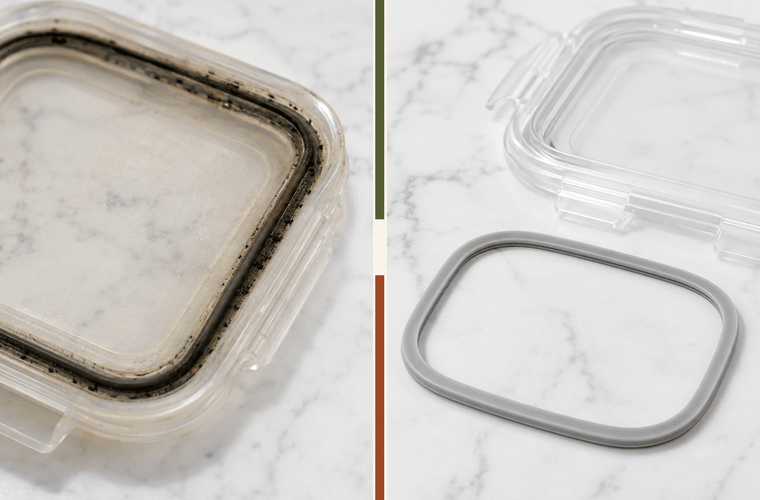
A leakproof glass container requires a snap-lock lid with four locking tabs and a continuous silicone gasket around the full perimeter. Two-tab locking lids are not fully leakproof — they seal the two locked sides but allow flex on the unlocked sides. Four-tab locking lids with silicone gaskets create a complete perimeter seal that is genuinely leakproof for liquids, soups, and sauces. |
The water test confirms seal quality: fill the container with water, close the lid, and invert it over a sink. Any dripping means air gets in and liquids get out. A genuine four-tab snap-lock lid with silicone gasket passes this test. All Razab glass food storage containers with lids use four-tab locking lids with continuous silicone gaskets. The seal is designed for soups, sauces, and marinating liquids — not just solid foods.
Best Glass Food Storage Container Sets — What to Buy
|
The right set depends on household size and use pattern. A single person who meal preps weekly needs different sizes than a family of four who batch cooks on weekends. The table below matches household type to the appropriate Razab set. |
|
Household / Use Case |
Recommended Set |
Sizes Included |
Why |
|
Single person — meal prep |
16-piece glass set |
Multiple 800ml and 1040ml sizes |
Covers a full week of single-portion meals |
|
Single or couple — full system |
24-piece glass set |
Range of sizes from small to medium-large |
Covers snacks, meals, and batch storage for 1 to 2 people |
|
Couple or small family — meal prep |
30-piece glass meal prep set |
Full range for 2-person weekly prep |
Dedicated meal prep sizes in a complete matched system |
|
Family or batch cooker |
35-piece glass set |
Complete range from snack to batch sizes |
Covers snacks through large family batches in one matched set |
|
Large family — full system |
10-piece glass set (Lisa) + large containers |
Variety sizes plus bulk storage |
Starter matched set with room to add large sizes |
|
Batch storage only |
2700ml + 3900ml + 6500ml individually |
Large and extra-large only |
Bulk batch storage without individual portion sizes |
For most households starting a glass container system, the 16-piece set covers the core meal prep sizes and the 30-piece meal prep set covers a complete weekly system. The 35-piece set is the most comprehensive option — it covers everything from snack portions to batch cooking in a single matched purchase.
Glass Food Storage Containers — Complete Appliance Safety Reference
|
Borosilicate glass handles every home kitchen appliance safely with the correct method for each. The rules are consistent: remove the lid before oven or air fryer use, vent or remove the lid for microwave use, thaw before moving from freezer directly to oven. |
|
Appliance |
Glass Body Safe? |
Lid Safe? |
Method |
Notes |
|
Oven |
Yes — up to 450°F |
No — remove lid |
Remove lid. Place in cold oven or thaw first if frozen. |
Lnk: freezer to oven guide |
|
Microwave |
Yes |
No — vent or remove |
Remove lid or use vent setting. |
Reheat in 90-second intervals for even heating |
|
Air fryer |
Yes — if container fits |
No — always remove |
1-inch clearance on all sides. |
Lnk: air fryer glass guide |
|
Freezer |
Yes |
Yes — loosely placed |
Fill to 75% for liquids. Lid loosely placed for first 12 hours. |
Lnk: freezer glass guide |
|
Dishwasher |
Yes |
Yes |
Top rack preferred for lids. Bottom rack safe for glass body. |
Lnk: dishwasher glass guide |
|
Refrigerator |
Yes |
Yes — sealed |
Seal completely for maximum freshness. |
All sizes fridge safe |
|
Stovetop |
No |
No |
Glass containers are not stovetop safe. |
Use stovetop-rated cookware |
The complete safety guides for each appliance: microwave | freezer | dishwasher | oven and thermal shock | air fryer.
Frequently Asked Questions
What are the best glass food storage containers?
Borosilicate glass containers with four-tab locking lids and silicone gasket seals — rated to 450°F, dishwasher safe, freezer safe, and microwave safe. Razab glass food storage containers are borosilicate with four-tab locking lids. The 35-piece set is the most comprehensive option covering snack to batch sizes in a matched system.
Are glass food storage containers better than plastic?
For most long-term use: yes. Glass is non-porous and does not absorb food odors, stains, or chemical compounds. After repeated use, glass looks and performs identically to its first use. Plastic stains from tomato and turmeric, absorbs food odors over time, and degrades structurally from repeated dishwasher cycles. Glass vs plastic food storage has the full material comparison.
Are Razab glass containers oven safe?
Yes — all Razab borosilicate glass containers are oven safe to 450°F with the lid removed. Do not place frozen glass containers directly into a preheated oven — thaw in the fridge overnight or use the cold-oven method (place in cold oven before turning it on). Freezer to oven glass guide has the complete protocol.
What size glass container do I need for meal prep?
800ml for single meals without sauce. 1040ml for single meals with sauce, protein, and vegetables. 1520ml for two-person batches. 2700ml for full weekly batch storage. The glass meal prep container collection covers all four sizes with matched lids.
Can glass food storage containers go in the freezer?
Yes — all Razab borosilicate glass containers are freezer safe. Fill to 75 percent maximum for liquid-containing foods to allow for expansion. Leave lids loosely placed for the first 12 hours when freezing liquids. Glass containers in the freezer has the full protocol including the headspace chart by container size.
Are glass food storage containers leakproof?
Razab glass containers use four-tab snap-lock lids with continuous silicone gaskets — genuinely leakproof for liquids, soups, and sauces. Two-tab lids are not fully leakproof. The water test confirms: fill with water, close the lid, invert over a sink. No dripping means a genuine airtight seal.
What is the difference between borosilicate and tempered glass containers?
Borosilicate glass is oven safe to 450°F and handles freezer-to-microwave transitions. Tempered glass is not reliably oven safe and does not handle significant temperature transitions as well. Both are dishwasher and fridge safe. All Razab glass food storage containers are borosilicate. Borosilicate vs tempered glass covers the complete material comparison.
How do I store glass food containers without lids falling out?
Lid management is the biggest challenge with glass container sets. Two approaches work: store lids in a vertical lid organizer on the shelf next to containers, or store each container with its lid nested inside rather than snapped on. Fridge organization with glass containers shows both systems with specific cabinet and shelf setups.
Glass food storage containers with locking lids are the correct long-term kitchen investment — non-porous, oven safe, freezer safe, dishwasher safe, and genuinely leakproof. Razab glass food storage containers range from 370ml glass snack containers to 6,500ml extra-large glass containers. For the right set size, the 16-piece set covers weekly single-person meal prep and the 35-piece set covers a complete household system. For the complete Razab kitchen guide, every Razab collection explained covers every product line with the specific use case for each.
|
About the Author Produced by the Razab Kitchen Research Team. We test borosilicate glass container performance across every common use scenario — meal prep, freezer storage, oven use, microwave reheating, and dishwasher safety. Razab is a woman-owned brand, designed in New York and trusted by over 1 million US families since 2017. Published: August 21, 2026 |
Conversation
Join the discussion