5 min read | Published: August 18, 2026

|
Quick Answer Borosilicate glass: safe for temperature changes up to 250°F (120°C). You can move it from a cold fridge to a warm oven safely — but not from a 0°F freezer directly into a 400°F preheated oven. Soda-lime glass (most cheap containers, older Pyrex): not safe for significant temperature transitions. It shatters. The safe method: thaw frozen glass in the fridge overnight, or use the cold-oven method — place the glass in the oven before preheating and let both warm up together. Never place a frozen glass container directly into a preheated oven regardless of glass type. |
The question is not whether glass can go from freezer to oven. The question is which glass and how fast. Moving borosilicate glass directly from a 0°F freezer into a 400°F preheated oven creates a 400-degree temperature differential — well beyond what even borosilicate handles safely. Moving the same container from a cold fridge to a warm oven is a different calculation entirely, and that transition is safe for borosilicate.
Thermal shock is the mechanism that makes glass shatter when temperature changes happen too fast. It is not the cold or the heat, it is the rate of change. Understanding what thermal shock actually is, and which glass type tolerates how much of it, is the difference between a container that lasts years and one that shatters in the oven.

The Science of Thermal Shock — Why Glass Shatters
|
Thermal shock happens when different parts of a glass object experience different temperatures at the same time. The hot part expands. The cold part contracts. The material cannot accommodate both forces simultaneously and fractures at the stress point. The faster the temperature change and the larger the differential, the higher the fracture risk. |
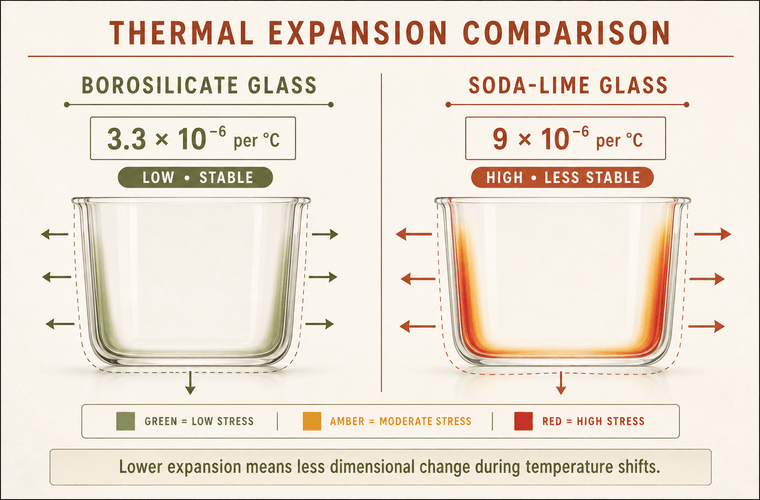
Every material has a thermal expansion coefficient — a measure of how much it expands per degree of temperature increase. Soda-lime glass has a high thermal expansion coefficient: 9 × 10⁻⁶ per °C. When the outer surface of a cold container heats rapidly, it expands dramatically while the cold interior has not yet warmed. The internal stress exceeds the glass's tensile strength and the container fractures — often explosively.
Borosilicate glass has a thermal expansion coefficient of 3.3 × 10⁻⁶ per °C — roughly one-third of soda-lime glass. When borosilicate heats unevenly, the differential expansion between hot and cold zones is so small that the glass can accommodate it without fracturing. This is the material property that makes borosilicate safe for freezer-to-microwave transitions and cold-oven methods. Borosilicate vs tempered glass covers the full material comparison for every common kitchen use scenario.
Does Glass Expand When Heated?
Yes, all glass expands when heated, but the expansion rate varies significantly by glass type and determines whether the glass survives rapid temperature changes.
Borosilicate glass expands at 3.3 × 10⁻⁶ per °C. Soda-lime glass expands at 9 × 10⁻⁶ per °C — nearly three times as much. When heat is applied unevenly, as it is when a cold container enters a hot oven, the difference in expansion rate between the hot outer surface and the cold inner core creates internal stress. In soda-lime glass, that stress exceeds the material's tensile strength quickly. In borosilicate, the lower expansion rate means the stress stays within the material's tolerance which is why thermal shock resistant cookware is almost exclusively made from borosilicate.
The practical consequence: glass that feels solid and heavy is not necessarily thermal shock resistant. Weight and visual quality tell you nothing about the thermal expansion coefficient. The only reliable indicator is the glass type listed in the product specifications borosilicate for high thermal shock resistance, soda-lime for standard kitchen use only.
Temperature Limit Comparison — Glass Types and Brands
|
The freezer-to-oven safety question has different answers for different glass types. Borosilicate handles it with proper thawing. Soda-lime glass does not handle it at all. The brand name on the container is less important than the glass type specified in the product description. |
|
Glass Type / Brand |
Max Oven Temp |
Freezer Safe? |
Thermal Shock Resistance |
Freezer to Oven Safe? |
|
Razab borosilicate |
450°F (230°C) |
Yes |
High — 120°C differential |
Yes — with thaw step. Never direct from 0°F to preheated oven. |
|
Pyrex (new, borosilicate — US) |
450°F (230°C) |
Yes |
High |
Yes — with thaw step |
|
Pyrex (older, some markets — soda-lime) |
350°F (177°C) |
Limited |
Low — high fracture risk |
No — do not attempt |
|
Anchor Hocking (tempered soda-lime) |
425°F (218°C) |
Yes (tempered) |
Moderate — better than regular soda-lime |
Only with very gradual warming |
|
Generic / no brand (soda-lime) |
Unrated |
Not recommended |
Low |
No |
|
JoyJolt (borosilicate) |
450°F (230°C) |
Yes |
High |
Yes — with thaw step |
|
Rubbermaid (borosilicate lids optional) |
Varies by product |
Yes |
Medium — check product specs |
Check product page |
The Pyrex row needs context. Pyrex switched many of its US products from borosilicate to soda-lime glass in the 1990s. Original Pyrex and current US Pyrex use different glass types. The borosilicate vs soda-lime question applies to Pyrex specifically because many households have older pieces they cannot reliably identify. The safest approach with any unlabeled glass: treat it as soda-lime and avoid thermal transitions.
3 Safe Methods to Move Glass From Freezer to Oven
|
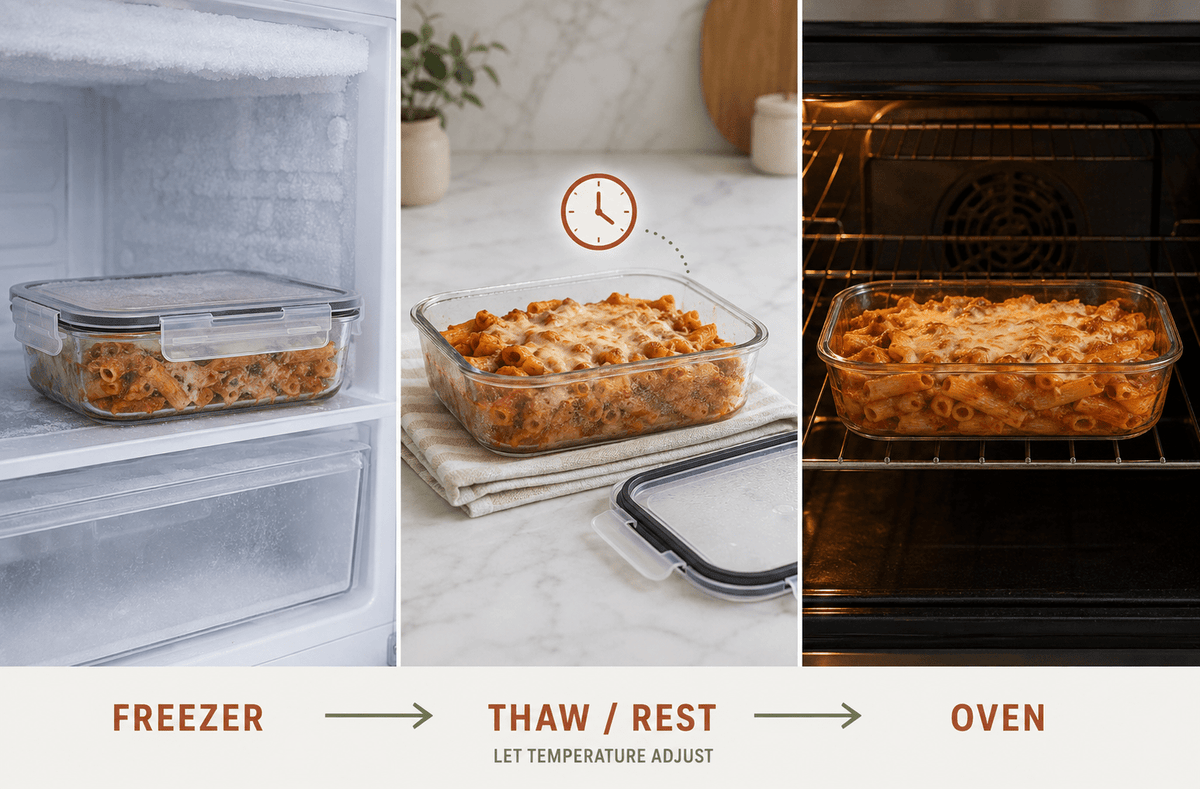
The problem is not moving frozen glass to the oven — it is the rate of temperature change. All three safe methods work by slowing that rate: overnight thaw, room temperature thaw, or the cold-oven method. The direct transfer method — freezer to preheated oven — is not safe for any glass type regardless of brand claims. |
Method 1 — Overnight Fridge Thaw (Best for Food Safety)
Move the frozen glass container from the freezer to the refrigerator the night before. By morning, the container is at approximately 35 to 40°F — a manageable starting temperature for oven use. Place the refrigerator-temperature container in the oven during preheating, not after. This is the safest method because it maintains food safety (food stays below 40°F throughout thawing) and the subsequent oven transition is gradual rather than abrupt.
Method 2 — Room Temperature Thaw (30 to 60 Minutes)
Remove the frozen container from the freezer and leave it at room temperature for 30 to 60 minutes before placing in the oven. At room temperature, the container reaches approximately 65 to 70°F. The remaining transition to oven temperature is still significant but substantially reduced compared to a direct freezer-to-oven transfer. Do not place a room-temperature container into a fully preheated oven — place it in during the last few minutes of preheating so the final temperature jump is gradual. Safe glass use in the microwave follows the same gradual warming principle for microwave reheating from cold.
Method 3 — Cold Oven Method (Best for Borosilicate)
Place the frozen borosilicate glass container directly in the cold oven before turning it on. Set the oven to the target temperature and let both the oven and the container warm together from the same starting point. This method works for borosilicate only — do not use it with soda-lime or unidentified glass. The gradual shared warming eliminates the temperature differential that causes thermal shock.
|
The Quick Check Before You Use the Oven ● Check the container base for 'borosilicate' or the oven-safe temperature rating — it should be 400°F or higher. ● If the container was in the freezer: use Method 1 (fridge thaw) or Method 3 (cold oven) — never direct to preheated oven. ● If the container was in the fridge: place in oven during preheating, not after. ● If you cannot identify the glass type: do not put it in the oven. |
Where is your glass container right now?
🧊 From the Freezer (0°F)
Do NOT place directly in a preheated oven. Option 1: Move to fridge overnight — safest for food safety. Option 2: Place in cold oven before turning on, let both warm together (borosilicate only). Option 3: Thaw at room temperature 45 to 60 minutes, then place in oven during last few minutes of preheating.
💡 Razab borosilicate handles the cold-oven method. Unidentified glass types should always use Option 1 (overnight fridge thaw).
❄️ From the Fridge (40°F)
Safe to go in the oven — with one step. Place during preheating, not after. A fridge-temperature container going into a fully preheated 400°F oven creates a 360-degree jump — reduce it by putting the glass in during the last 5 minutes of preheating.
💡 This is the most common scenario for glass meal prep containers — and the safest starting position for oven use.
🌡️ Room Temperature
Safe to place in a preheated oven for borosilicate glass. The temperature differential from 70°F to 400°F is within borosilicate's safe range when the container starts at room temperature rather than frozen. Place in oven normally.
💡 Always remove the lid before placing any glass container in the oven — lids are not oven safe.
Frequently Asked Questions
Can you put a cold glass dish in a preheated oven?
Fridge-temperature glass (40°F) going into a preheated oven: safe for borosilicate if you place it during preheating rather than after. Freezer-temperature glass (0°F) going into a preheated oven: not safe for any glass type — the temperature differential is too high. Always thaw frozen glass before oven use. Hot food in glass containers covers the reverse scenario — moving hot glass to cold surfaces.
What glass is safe for thermal shock?
Borosilicate glass has a thermal expansion coefficient approximately one-third of soda-lime glass, giving it significantly better thermal shock resistance. It can safely handle temperature differentials up to approximately 250°F (120°C) with proper transition methods. Tempered glass (like some Anchor Hocking products) has moderate thermal shock resistance. Standard soda-lime glass is not safe for significant thermal transitions.
Can borosilicate glass go from freezer to oven?
Yes, with a thaw step. Borosilicate glass cannot go directly from a 0°F freezer into a 400°F preheated oven — the 400-degree differential exceeds its safe range. Use the overnight fridge thaw method, the room-temperature thaw method, or the cold-oven method (place in cold oven before turning it on). All three keep the temperature transition rate within borosilicate's safe range.
Why did my glass container shatter in the oven?
Three common causes: the glass was soda-lime rather than borosilicate; the container went from freezer to preheated oven without thawing; or the container was placed on a cold, wet surface immediately after coming out of the oven (thermal shock in reverse). Glass vs plastic food storage covers why borosilicate specifically is the safer material for temperature-variable cooking.
Can Razab glass containers go from freezer to oven?
Razab containers are made from borosilicate glass rated to 450°F. With proper thawing — overnight in the fridge, or using the cold-oven method — they can go from freezer storage to oven use. Direct transfer from a 0°F freezer to a preheated oven is not recommended for any glass regardless of the borosilicate rating. Razab glass food storage containers includes the full oven and freezer specifications.
Borosilicate glass handles freezer-to-oven transitions safely when the temperature change is gradual — overnight thaw, room-temperature thaw, or the cold-oven method. The material handles it. The rate of change is what matters. Razab glass meal prep containers are rated to 450°F and built for exactly this freezer-to-oven workflow. For the complete guide to what glass handles in the kitchen, non-toxic food storage covers every material safety question across glass, plastic, and silicone.
|
About the Author Produced by the Razab Kitchen Research Team. We test glass container performance across every common kitchen scenario including thermal transitions, air fryer use, and freezer-to-stovetop workflows. Razab is a woman-owned brand, designed in New York and trusted by over 1 million US families since 2017. Published: August 18, 2026 |
Conversation
Join the discussion