4 min read | Published: August 18, 2026

|
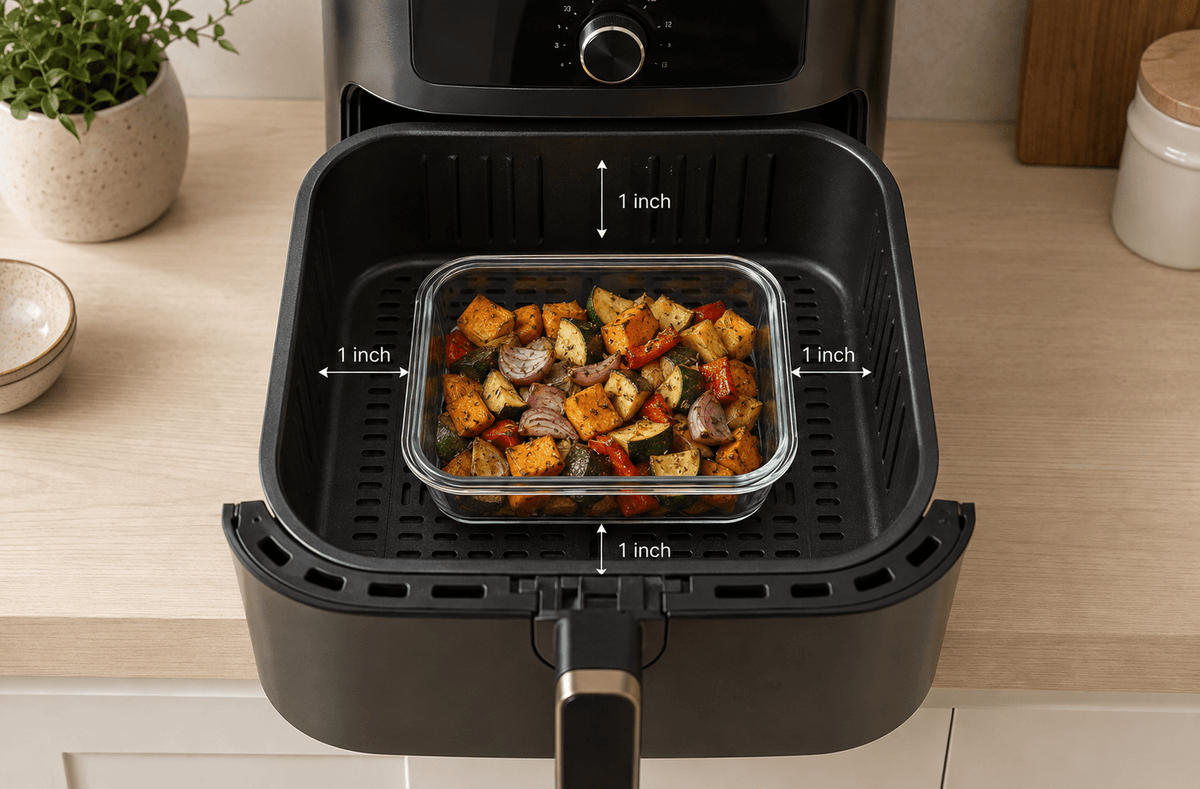
Quick Answer Yes — oven-safe borosilicate glass without the lid is safe in an air fryer up to 400°F (200°C). The lid must be removed. Air fryer temperatures and air circulation create pressure and heat buildup under sealed lids. The container must fit with at least 1 inch of clearance on all sides. Air fryers need airflow to function — a container that fills the basket blocks circulation and creates hot spots. Standard soda-lime glass and non-oven-rated glass: do not use in an air fryer. |
Air fryers are convection ovens with a small cooking chamber and very high airflow. The temperature range — typically 300°F to 400°F — is within the safe range for oven-rated borosilicate glass. The key variables are the airflow requirement (clearance around the container) and the lid (which must always come off). Get those two things right and glass works well in an air fryer.
Most meal prep glass containers are sized for refrigerator and oven use — their dimensions were not designed with air fryer basket geometry in mind. Fit is the practical limiting factor, not material safety. A container that technically tolerates air fryer temperatures but fills 90 percent of the basket will produce uneven results and risk hot-spot fracture from inconsistent heat distribution.

Quick Answer: Is Glass Safe in an Air Fryer?
|
Yes — oven-safe borosilicate glass without lids is safe up to 400°F (200°C) in an air fryer, provided the container fits with 1 inch of clearance on all sides for airflow. Remove the lid entirely before air frying. Check the container base for an oven-safe rating of 400°F or higher before use. |
The clearance rule is the one most people miss. Air fryers cook through rapid hot air circulation — not direct heat. A container that blocks significant airflow in the basket prevents the air from reaching the food surface and creates an uneven temperature distribution around the glass. Localized hot spots on the glass surface create thermal stress that can cause fracture even in borosilicate glass, because the temperature differential across the container surface exceeds the material's tolerance.
Glass vs Silicone vs Metal in an Air Fryer
|
Each material behaves differently in an air fryer. Metal heats fastest and handles airflow best. Silicone is flexible but insulates food from direct hot air. Glass heats evenly but requires clearance and no lid. The best choice depends on what you are reheating or cooking. |
|
Material |
Max Temp |
Heat Retention |
Airflow Friendly? |
Toxicity Concern |
Best For |
|
Borosilicate glass (oven-rated) |
450°F (230°C) |
High — stays hot longer |
Moderate — needs 1-inch clearance |
None |
Reheating dense foods, casseroles, leftovers |
|
Silicone (food-grade) |
400°F to 450°F |
Low — insulates |
Good — flexible sides allow airflow |
None at food-grade temps |
Muffins, egg bites, flexible molds |
|
Aluminum (dark, anodized) |
Any air fryer temp |
Medium |
Excellent — promotes crisp browning |
None (food-grade anodized) |
Anything where browning matters — fries, wings |
|
Stainless steel |
Any air fryer temp |
Medium |
Excellent |
None |
General cooking, reheating |
|
Ceramic |
400°F to 450°F |
Very high |
Poor — solid sides block airflow |
None |
Small portions that need high moisture retention |
|
Plastic (any type) |
Not safe |
N/A |
N/A |
Yes — melts and leaches |
Never use in air fryer |
|
Glass with snap-lock lid |
N/A — remove lid |
N/A |
N/A |
N/A — lid not air fryer safe |
Always remove lid before air frying |
Glass is not the ideal air fryer material for foods where browning and crisping matter — glass does not promote browning the way dark metal does because it reflects more heat rather than conducting it into the food surface. For reheating dense foods — lasagna, casseroles, soups, dense meal prep portions — glass works well. For crisping foods, use metal. The choice of material is about the cooking outcome, not just safety. Glass vs plastic food storage covers the full material comparison for storage — the cooking properties follow different logic.

3 Mistakes That Crack Glass in an Air Fryer
|
Most glass failures in air fryers come from one of three mistakes: leaving the lid on, insufficient clearance causing hot spots, or placing a hot glass container on a cold surface immediately after air frying. All three are preventable. |
Mistake 1 — Leaving the Lid On
Air fryers build pressure inside their cooking chamber through rapid air circulation. A snap-lock lid on a glass container inside an air fryer can build significant internal pressure as the food heats and steam accumulates. The pressure differential between inside and outside the container — combined with the heat — creates stress on the lid seal and the container walls. Always remove the lid entirely. If covering is needed for moisture retention, use a sheet of aluminum foil laid loosely over the container.
Mistake 2 — Container Too Large for the Basket
A container that fills 80 to 90 percent of the basket cross-section blocks the hot air circulation that makes air fryers work. The air cannot reach the sides of the container, creating a thermal differential between the hot top surface and the cooler sides. In glass, this uneven heat distribution creates localized stress that can cause cracking even in borosilicate. Measure your container and air fryer basket before use — there should be at least 1 inch of space between the container and basket walls on all sides.
Mistake 3 — Cold Surface Immediately After Air Frying
A glass container that comes out of a 400°F air fryer is extremely hot — the glass itself is at oven temperature. Setting it directly on a cold marble countertop, a metal sink, or a cold ceramic tile creates the same thermal shock mechanism as putting cold glass in a hot oven, just in reverse. Place hot glass on a wooden cutting board or a trivet — never on a cold, hard, or wet surface. Hot food in glass containers covers this exact scenario in more detail.

Frequently Asked Questions
Will glass shatter in an air fryer?
Oven-safe borosilicate glass will not shatter in an air fryer if the lid is removed and there is 1-inch clearance around the container. Soda-lime glass and unrated glass should not be used in an air fryer. The three causes of glass failure in air fryers are: sealed lid creating pressure buildup, insufficient clearance causing hot spots, and placing hot glass on a cold surface after cooking. Can glass go from freezer to oven covers the same thermal dynamics in more detail.
What glassware is air fryer safe?
Oven-rated borosilicate glass containers without lids, marked safe to 400°F or higher. The container must fit in the basket with at least 1-inch clearance on all sides. Check the base of the container for an oven-safe temperature rating — if the rating is absent or below 400°F, do not use it in an air fryer.
Can Razab glass containers go in an air fryer?
Razab borosilicate glass containers are rated to 450°F and can be used in an air fryer without the lid, with adequate basket clearance. Remove the snap-lock lid completely before air frying. Check that the container fits with at least 1 inch of space on all sides. Razab glass meal prep containers come in multiple sizes — measure against your air fryer basket before use.
Is glass or silicone better for an air fryer?
For reheating dense foods and leftovers: glass is better — it retains heat evenly and does not absorb food odors. For baking and flexible molds like egg bites or muffins: silicone is better — it is lighter, fits more air fryer shapes, and allows more airflow. For browning and crisping: neither — use dark metal for best crisping results in an air fryer.
Oven-safe borosilicate glass in an air fryer: lid off, 1-inch clearance, no cold surface after. Those three rules cover everything. Razab glass food storage containers are oven-rated to 450°F and work in air fryers within these parameters. For the complete kitchen safety guide for glass containers across oven, microwave, freezer, and dishwasher use, safe glass use in the microwave and glass containers in the dishwasher cover the remaining appliance scenarios.
|
About the Author Produced by the Razab Kitchen Research Team. We test glass container performance across every common kitchen scenario including thermal transitions, air fryer use, and freezer-to-stovetop workflows. Razab is a woman-owned brand, designed in New York and trusted by over 1 million US families since 2017. Published: August 18, 2026 |
Conversation
Join the discussion