7 min read | Published: August 11, 2026

|
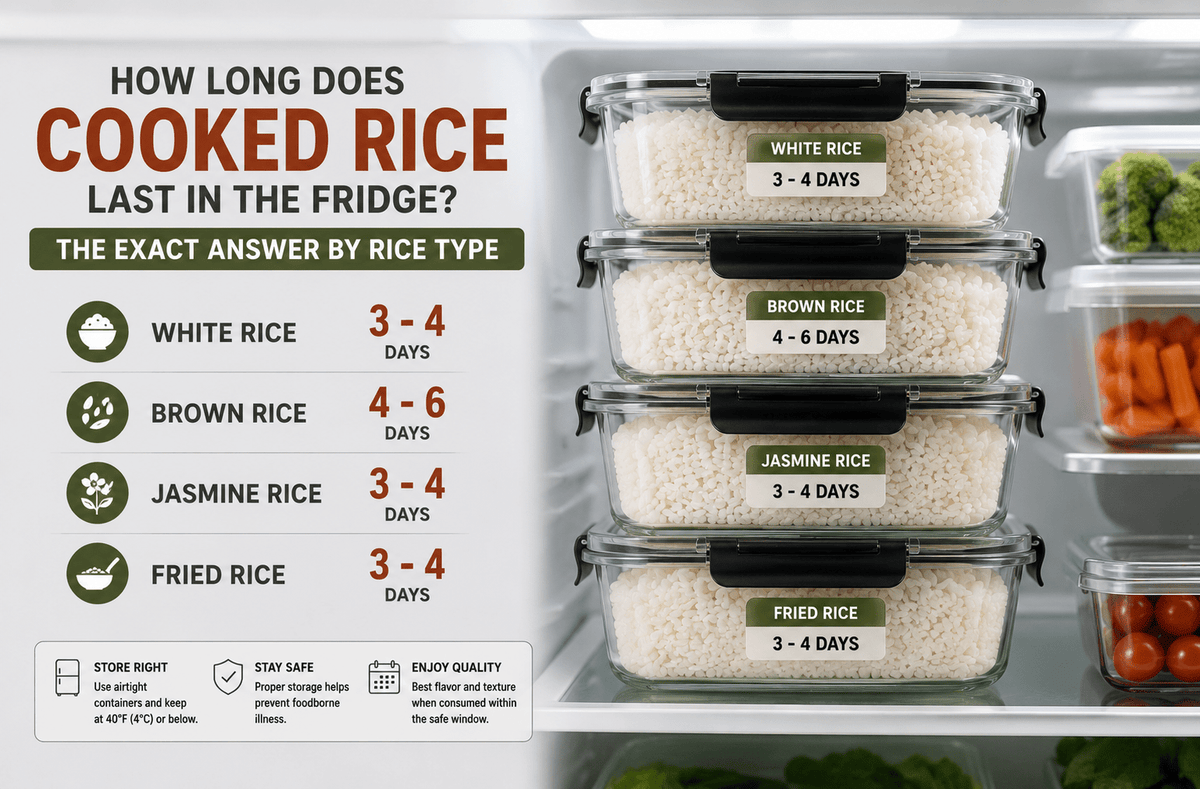
Quick Answer White rice, jasmine, basmati, sushi rice: 3 to 4 days refrigerated in a sealed airtight container. Brown rice: 2 to 3 days — shorter because bran layer oils degrade faster after cooking. Fried rice: 3 to 4 days. Rice with vegetables or protein mixed in: 3 days maximum. Critical rule: refrigerate cooked rice within 1 hour of cooking — not 2 hours like other leftovers. Rice is high-risk for Bacillus cereus. In the freezer: 1 to 2 months for best texture. Safe indefinitely at 0°F. |
The 1-hour rule is the most important thing to know about storing cooked rice — and most sources get it wrong. USDA guidelines say cooked food can sit at room temperature for 2 hours before refrigerating. Rice is the exception. America's Test Kitchen's food safety testing confirmed that Bacillus cereus spores in rice convert to live bacteria faster than other foods between 40°F and 140°F. Cooked rice left at room temperature for more than 1 hour is meaningfully higher risk than most other leftovers.
With that said, refrigerated rice stored in a properly sealed container is safe and good for 3 to 4 days. The container choice changes this meaningfully. Glass vs plastic food storage documents that glass is non-porous it does not absorb the cooked grain smell that builds up in plastic containers over repeated use, which is why rice stored in glass through day 4 tastes noticeably fresher than rice stored in plastic for the same time.

Cooked Rice Shelf Life by Rice Type
|
The shelf life of cooked rice in the fridge is 3 to 4 days for most varieties. Brown rice is the exception — its bran layer contains natural oils that oxidize faster after cooking, reducing its quality window to 2 to 3 days. Mixed rice dishes with protein or sauce have the shortest window because the added ingredients introduce their own timelines. |
|
Rice Type |
Fridge (sealed container) |
Freezer |
What Limits It |
|
White rice |
3 to 4 days |
1 to 2 months |
Bacillus cereus risk if not refrigerated quickly |
|
Brown rice |
2 to 3 days |
1 month |
Bran oil oxidation — goes stale and slightly rancid faster |
|
Jasmine rice |
3 to 4 days |
1 to 2 months |
Same as white rice — refined grain, minimal oils |
|
Basmati rice |
3 to 4 days |
1 to 2 months |
Same as white rice |
|
Sushi rice |
3 to 4 days |
Not recommended — texture degrades |
Vinegar seasoning changes texture after freezing |
|
Wild rice |
4 to 5 days |
2 months |
Denser grain, lower moisture content after cooking |
|
Fried rice |
3 to 4 days |
1 to 2 months |
Egg and vegetable additions — use the shortest timeline of any ingredient |
|
Rice with mixed protein |
3 days maximum |
1 to 2 months |
Protein shelf life limits the whole container |
|
Rice pilaf (with broth) |
3 to 4 days |
1 to 2 months |
Broth adds moisture — check for sour smell before eating |
The fried rice and mixed protein rows matter most for meal prep. When rice is stored alongside chicken, salmon, or ground beef, the shortest shelf life in the container applies to the entire portion. Chicken with rice: 3 days maximum, not 4. Salmon with rice: 2 to 3 days. This is the most common meal prep food safety mistake — assuming the grain timeline applies when the protein timeline is shorter. Meal prep shelf life by food type covers every combination.
🍚 What rice are you storing? Check how long it lasts.
The Bacillus Cereus Risk — Why Rice is Different From Other Leftovers
|
Bacillus cereus is a spore-forming bacterium naturally present in raw rice. Cooking kills the live bacteria but does not destroy the spores. At temperatures between 40°F and 140°F, those spores germinate into live bacteria that produce toxins. The toxins are heat-stable — reheating rice that has developed them does not make the rice safe. This is why the storage window and refrigeration speed both matter for cooked rice specifically. |
Most food safety guidelines say the two-hour rule: refrigerate cooked food within 2 hours of cooking. Rice is the exception that most home cooks do not know about. America's Test Kitchen's food science testing found that cooked rice cools more slowly than most foods because of its density and moisture content, meaning it spends more time in the bacterial growth temperature zone (40°F to 140°F) than thinner foods do. Their recommendation, consistent with food safety authorities, is to refrigerate cooked rice within 1 hour.
The practical fix: spread cooked rice in a thin layer across the container rather than piling it deep. A shallow layer in an 800ml or 1040ml Razab container cools to safe temperature significantly faster than the same rice piled into a deep 2700ml container. Portion size directly affects cooling speed and therefore food safety. Once cooled and sealed, glass maintains the internal temperature more consistently than plastic because of its higher thermal mass. Glass vs plastic for food storage covers the material science behind why glass performs better for food that needs to stay cold.
|
Fun Fact: The 2024 CDC Food Safety Report identified cooked rice as one of the top 10 foods associated with foodborne illness outbreaks in US households — specifically from Bacillus cereus toxin production in rice left at room temperature for more than 1 hour. The illness causes vomiting within 1 to 5 hours or diarrhea within 6 to 15 hours. Unlike most bacterial illnesses, reheating the rice does not remove the risk because B. cereus toxins are heat-stable. |
How to Store Cooked Rice in the Fridge — The Correct Method
|
Three variables determine whether cooked rice stays safe and good for the full 3 to 4 days: how quickly it is cooled and refrigerated, what container it goes into, and whether the container is genuinely airtight. Get all three right and rice is safe through day 4. Miss any one of them and the window shortens. |
Step 1: Cool Fast
Spread cooked rice in a thin layer in the container immediately after cooking. Do not pile it deep. A thin layer in an 800ml glass container reaches safe temperature in 20 to 30 minutes. The same volume piled deep in a large container can take 90 minutes to cool through to the center. Seal the container only after the rice has cooled — sealing hot rice traps steam and creates condensation that softens the grain texture and introduces moisture that accelerates bacterial growth.
Step 2: Choose the Right Container Size
Match the container to the portion, not to the total batch. A single serving of cooked rice — approximately ¾ cup to 1 cup — fits correctly in an 800ml container. A two-person portion fits in a 1040ml container. A full batch for weekly meal prep storage fits in the 1520ml or 2700ml container. Excess headspace above the rice means excess air exposure and faster quality decline, even in a sealed container. Glass container sizes explained has the full sizing guide across every common meal prep food.
Step 3: Seal Properly
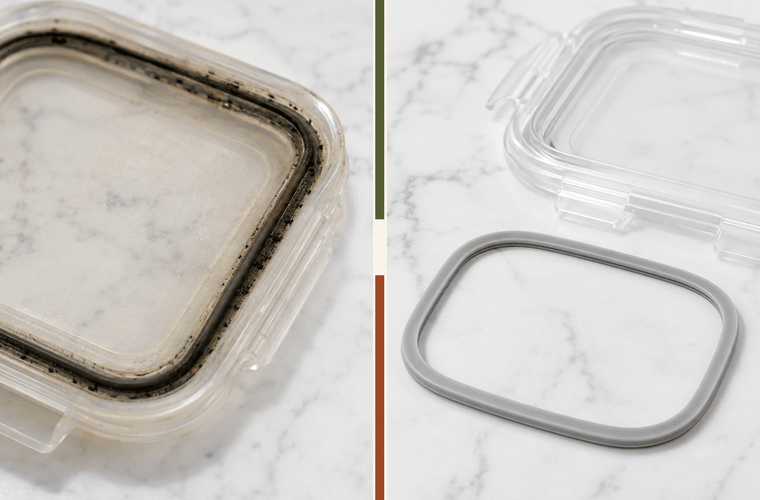
The snap-lock silicone gasket lid on Razab containers creates a genuine airtight seal — not a press-fit that allows continuous slow air exchange. Non-toxic food storage covers why the gasket material matters: silicone does not degrade at refrigerator temperatures and does not absorb food compounds the way rubber gaskets do over repeated use. Check the gasket for cracks every 6 months — a cracked gasket breaks the airtight seal and reduces all freshness timelines.
|
Label System for Rice Meal Prep ● Write the cook date on a piece of masking tape on the lid — not the expiration date. ● Day 1 = day cooked. Day 4 = last safe day for white rice. Day 3 = last safe day for brown rice. ● If rice is mixed with protein, write both the cook date and the protein type. The protein determines the timeline. ● Use a different color tape for rice with protein to visually distinguish it from plain rice at a glance. |

How to Tell If Cooked Rice Has Gone Bad
|
Three checks: smell, texture, and appearance. Cooked rice that has gone bad has a sour or off smell, a sticky or slimy texture on the surface of the grains, or visible mold. Any one of these is a discard signal. The absence of all three does not guarantee safety — Bacillus cereus toxins are odorless and colorless — which is why the 3 to 4 day guideline exists as an absolute limit. |
||
|
Sign |
What It Means |
Action |
|
Sour or off smell |
Bacterial activity — do not taste to check |
Discard entire container |
|
Slimy or sticky grain surface |
Surface bacterial growth |
Discard entire container |
|
Visible mold (any color) |
Moisture entry plus bacterial growth |
Discard entire container |
|
Dry and hard texture |
Moisture loss — not a safety issue |
Safe but poor quality — add splash of water when reheating |
|
Slightly flat smell, no sour note |
Staling — not spoilage |
Safe through day 4, quality declining |
|
No changes, stored 4+ days |
Unknown toxin level — cannot smell toxins |
Discard regardless of appearance |
The last row is the most important. Bacillus cereus toxins are odorless. Rice that smells and looks completely fine on day 5 or 6 may still cause food poisoning. The 3 to 4 day rule is not a guideline — it is based on the known toxin production timeline. USDA FoodKeeper guidelines list cooked rice as 3 to 4 days maximum with no exceptions for appearance or smell.
Can You Freeze Cooked Rice?
|
Yes — cooked rice freezes well and reheat quality is high, especially for white rice, jasmine, and basmati. Freeze in meal-sized portions in glass containers at 0°F. Rice lasts 1 to 2 months in the freezer for best quality and remains safe indefinitely at 0°F, though texture declines significantly after 2 months. |
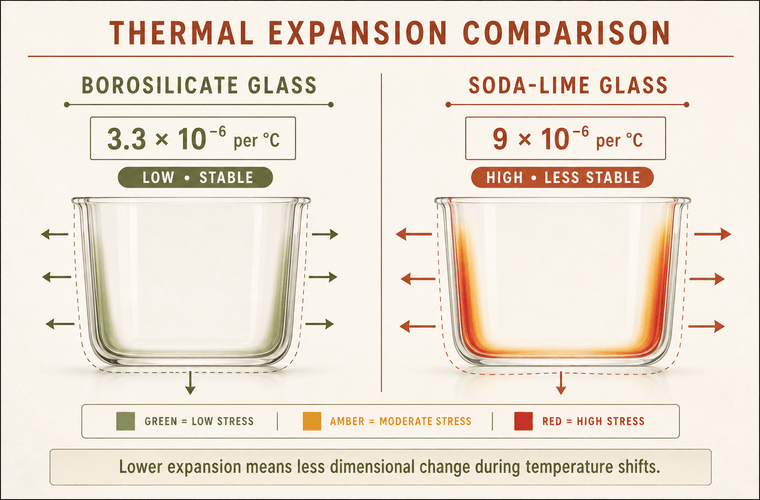
The freezing method matters. Freeze rice in the same glass meal prep containers it will be reheated in — no transfer needed. Fill to 75 percent maximum because food expands when frozen. Borosilicate glass handles the temperature change from freezer to microwave without cracking. Glass containers in the freezer entails the headspace rules and the freezer-to-microwave transfer protocol for every container size.
For batch-cooked rice destined for weekly meal prep, freeze individual portions Sunday and move one container to the fridge each morning. This approach gives the same convenience as meal-prepped refrigerated rice with a significantly longer total freshness window. 5 dinners prepped in 1 hour demonstrates this exact system applied to a full week of meals.
Frequently Asked Questions
How long does cooked rice last in the fridge?
3 to 4 days for white rice, jasmine, basmati, and wild rice in a sealed glass container. Brown rice: 2 to 3 days. Rice mixed with protein: use the shorter protein timeline, typically 3 days maximum. Per USDA FoodKeeper guidelines, 3 to 4 days is the absolute limit do not eat cooked rice past day 4 regardless of appearance or smell.
Can you eat cooked rice after 4 days?
No. Bacillus cereus toxins the primary food safety concern with cooked rice — are odorless and colorless. Rice that looks and smells fine on day 5 or 6 may still cause food poisoning. The 3 to 4 day limit is based on known bacterial toxin timelines, not visible spoilage. Discard any cooked rice past day 4.
Why should cooked rice be refrigerated within 1 hour?
Bacillus cereus spores are naturally present in raw rice and survive cooking. Between 40°F and 140°F, they germinate into live bacteria that produce heat-stable toxins. Rice cools more slowly than most foods because of its density. America's Test Kitchen's food safety testing recommends refrigerating within 1 hour — faster than the 2-hour rule that applies to most other leftovers.
How long does brown rice last in the fridge?
2 to 3 days. Brown rice retains its bran layer, which contains natural oils that oxidize faster after cooking. By day 3, the texture and flavor of refrigerated brown rice decline noticeably. How much does rice expand when cooked covers the volume and container sizing differences between brown and white rice for meal prep.
What is the best container for storing cooked rice in the fridge?
An airtight glass container sized to the portion — 800ml for a single serving, 1040ml for a two-person portion. Glass is non-porous, does not absorb cooked grain smell, and goes from fridge to microwave in the same container. Glass meal prep containers are available in sets covering every portion size from single servings to batch storage.
Can you reheat rice twice?
No. Rice should be reheated once only and to a minimum of 165°F throughout. Each reheat cycle increases the risk of Bacillus cereus toxin exposure. Portion rice into individual serving containers before refrigerating — this way each container is reheated once and finished in one sitting.
Cooked rice is safe in the fridge for 3 to 4 days when stored in a sealed glass container and refrigerated within 1 hour of cooking. Brown rice: 3 days. Rice with protein: use the shorter protein timeline. Razab glass meal prep containers in 800ml and 1040ml are sized for single and two-person portions available in the 30-piece meal prep set that covers every size for a full week of rice-based meal prep. For the complete leftover food safety guide across every food type, leftover shelf life covers every common meal prep food with the same USDA-aligned timelines.
|
About the Author Produced by the Razab Meal Prep Research Team. We test how storage conditions affect food safety and freshness for every common meal prep staple. All food safety timelines follow USDA FoodKeeper guidelines. Razab is a woman-owned brand, designed in New York and trusted by over 1 million US families since 2017. Published: August 11, 2026 |
Conversation
Join the discussion