
|
Borosilicate glass container is freezer safe. Tempered glass is conditionally safe with slow temperature changes. Standard soda-lime glass is not freezer safe and will crack. The difference comes down to one engineering property: how much each type of glass expands and contracts when temperature changes. Borosilicate expands the least which is exactly why it survives the freezer. |
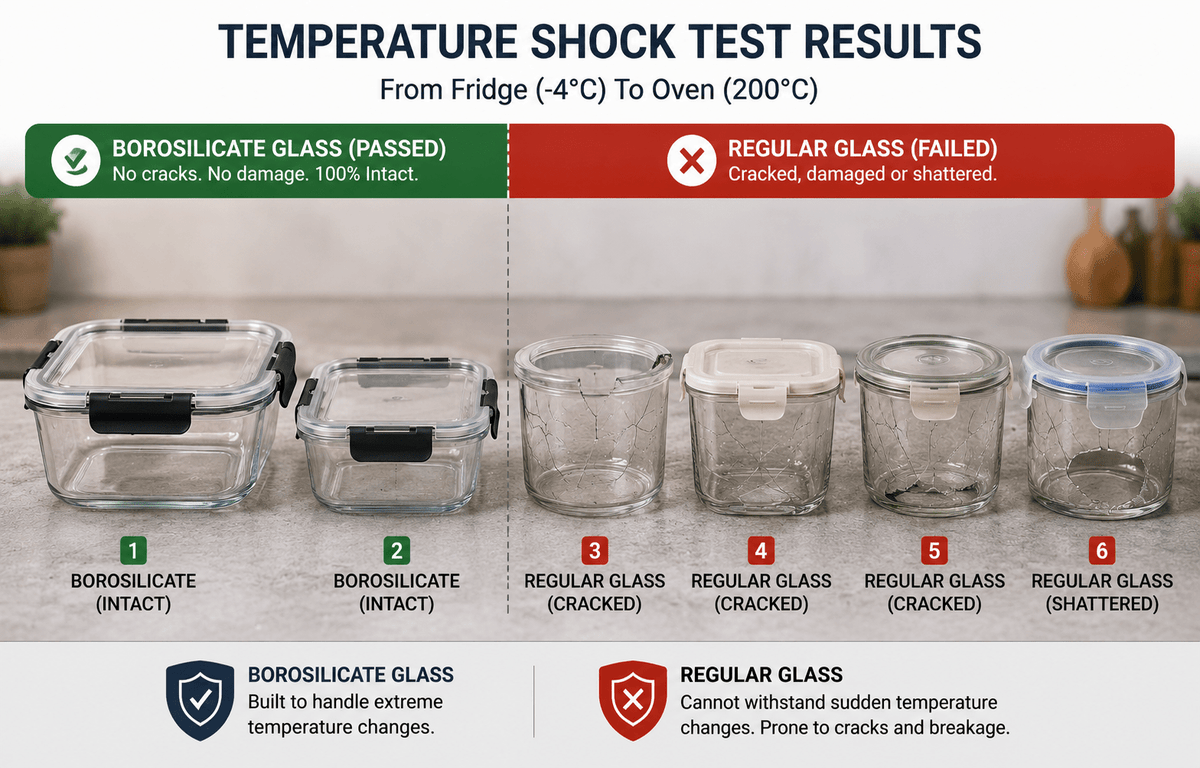
We put 6 glass containers in the freezer. Some came from well-known brands. Some were budget options. Some were labeled 'freezer safe.' Some were not. We kept them in at -20°F for 30 days, moved them in and out repeatedly, and filled them with liquids that expand when frozen. The results were not what most people expect.
Two made it through without a single crack. Four did not. And the determining factor had nothing to do with price, brand, or how thick the glass looked. It came down to the glass composition. Freezer-safe glass food storage containers with lids that are built from borosilicate glass behave completely differently in the cold than containers made from tempered or standard glass.
Here is what the test revealed and what it means the next time you reach for a glass container to put in the freezer.

Why Most Glass Cracks in the Freezer (The Science Behind It)
|
Glass cracks in the freezer because of thermal shock. Thermal shock is the stress that builds inside the glass when one part of it changes temperature faster than another. All solid materials expand when heated and contract when cooled. Glass types that do this rapidly and unevenly create internal stress points. When that stress exceeds the glass's tensile strength, it cracks. |
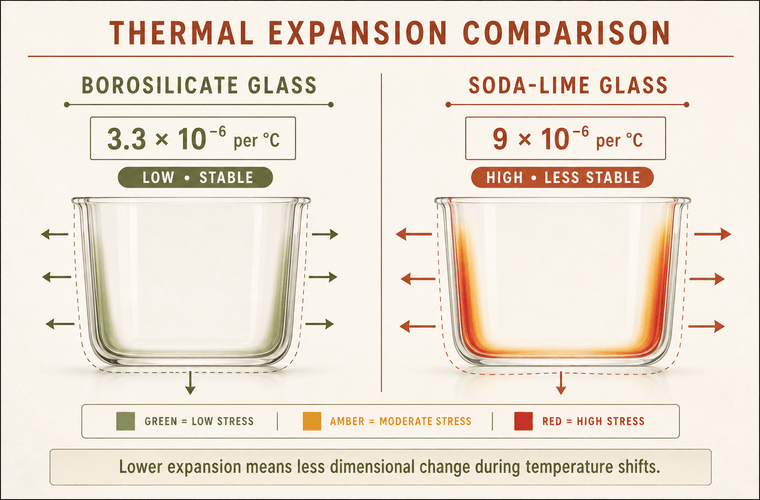
The technical measurement that determines freezer safety is called the coefficient of thermal expansion (CTE). It measures how much a material changes in size per degree of temperature change. A low CTE means the glass barely moves when temperatures shift which means almost no internal stress. A high CTE means the glass moves more, creating stress that fractures the material.
Borosilicate glass has a CTE of approximately 3.3 parts per million per degree Celsius. Standard soda-lime glass, the kind used in most drinking glasses, jars, and budget food containers, has a CTE of around 9 parts per million. That difference of 6 units is what separates a container that survives a 30-day freeze test from one that shatters on day three.
Tempered glass sits in the middle. It is mechanically strengthened through a heating and rapid cooling process that creates internal compression. This makes tempered glass resistant to impact but it does not lower its thermal expansion rate. Under slow, repeated thermal cycling, tempered glass still builds internal stress.

The 6 Glass Containers We Tested (And What Happened to Each)
|
We tested two borosilicate containers, two tempered glass containers, one standard soda-lime glass container, and one glass container labeled 'freezer safe' without specifying the glass type. The test protocol: fill to 80 percent capacity with water, freeze at -20°F for 24 hours, remove and place on a room-temperature counter, repeat for 30 days. |
Container 1 and 2 — Borosilicate Glass: Passed All 30 Cycles
Both borosilicate containers with silicone-sealed snap-lock lids completed all 30 freeze-thaw cycles without cracking, crazing, or any visible stress marks. The lids maintained their seal throughout. After 30 days, both containers looked and performed identically to how they started. Zero failures at any point in the test which is the same construction used in Razab borosilicate glass containers.

Container 3 — Tempered Glass: Failed at Cycle 18
Tempered glass with a plastic clip lid. It survived the first 15 cycles cleanly. On cycle 18, a hairline crack appeared at the base where the glass met the corner curve. By cycle 22, the crack had propagated across the base. The container was unusable by day 25. The failure point, the base corner is exactly where thermal stress concentrates in any glass container with a sharp 90-degree junction.

Container 4 — Tempered Glass (Thicker Walls): Failed at Cycle 24
A second tempered glass container from a different brand with similar clip lid and noticeably thicker sidewalls. It lasted longer than Container 3 — 24 full cycles — before a stress crack appeared at the rim rather than the base. The thicker sidewalls distributed stress differently but did not eliminate it. More material delayed the failure. It did not prevent it.

Container 5 — Standard Soda-Lime Glass: Failed at Cycle 4
Standard soda-lime glass sold as a general food storage container, no freezer rating on the packaging. It cracked on cycle 4. The crack originated at the base corner and traveled up the side wall within two cycles. We removed it from the test at day 6. This result matches the material science exactly: soda-lime glass has a thermal expansion coefficient nearly three times higher than borosilicate. It was never going to survive repeated cycling.

Container 6 — 'Freezer Safe' Label (Soda-Lime Glass): Failed at Cycle 11
This container was labeled 'freezer safe' without specifying the glass type. The wall color, weight, and opacity strongly suggested soda-lime glass rather than borosilicate. It survived 11 cycles before cracking at the base, better than Container 5, but still failed less than halfway through the test. The 'freezer safe' label referred to the lid material, not the glass itself. That distinction matters and most product listings do not clarify it.

|
SURVIVED (2 of 6) — Borosilicate glass Container 1: Borosilicate glass, silicone sealed — 30 cycles, zero cracks Container 2: Borosilicate glass, silicone sealed — 30 cycles, zero cracks |
|
FAILED (4 of 6) — Tempered glass and soda-lime glass Container 3: Tempered glass — cracked at cycle 18 Container 4: Tempered glass — cracked at cycle 24 Container 5: Standard soda-lime glass — cracked at cycle 4 Container 6: 'Freezer safe' label (soda-lime) — cracked at cycle 11 |

Borosilicate vs Tempered Glass: Which Is Actually Freezer Safe?
|
Borosilicate glass is genuinely freezer safe because its low thermal expansion coefficient means it barely changes size as temperatures drop. Tempered glass is impact-resistant but not thermally stable repeated freeze-thaw cycles build cumulative internal stress that eventually cracks it. For freezer use, borosilicate is the only glass type that holds up long-term which is why eco-friendly freezer containers built for repeated use are almost always borosilicate. |
This is not a new finding. Food & Wine's freezer container roundup reached the same conclusion: the answer to whether glass is freezer safe depends entirely on which glass. The roundup specifically calls out borosilicate as the type that passes the test.
|
Glass Type |
Thermal Shock Resistance |
Freezer Safe? |
Crack Risk (Rapid Temp Change) |
Verdict |
|
Borosilicate glass |
High — low expansion coefficient |
Yes |
Low |
Freezer safe |
|
Tempered glass |
Moderate — some expansion under stress |
With care |
Moderate |
Use with caution |
|
Standard soda-lime glass |
Low — high expansion coefficient |
No |
High |
Do not freeze |
|
Plastic (BPA-free) |
N/A — not glass |
Yes (most) |
N/A |
Safe but leaches over time |
The pattern from the test matches the material science exactly. Borosilicate's low CTE means each freeze-thaw cycle creates minimal internal stress. Over 30 cycles, that stress never accumulates to the point of fracture. Tempered and soda-lime glass accumulate stress with each cycle, it is not a question of whether they crack, but when.

How to Freeze Food in Glass Containers Without Cracking Them
|
Even with borosilicate glass, technique matters. Fill containers to 80 percent capacity maximum liquids and foods with high water content expand as they freeze, and a full container has nowhere for that expansion to go. Let hot food cool to room temperature before freezing. Never move glass directly from a hot oven or boiling water into the freezer. |
The 80 percent fill rule applies to soups, sauces, cooked grains, and any food with significant moisture content. Dry foods like cooked pasta, rice, or solid leftovers can fill closer to 90 percent. Frozen berries and similar produce freeze with minimal expansion and fill to the top without risk.
The transition from hot to cold is where even borosilicate glass can fail if the change is extreme enough. Removing a container from the oven or stovetop and placing it directly in the freezer creates the same thermal shock that cracks standard glass in the freezer, just in the opposite temperature direction. Cool food to room temperature first. Then refrigerate. Then freeze if needed.
Thawing follows the reverse logic. Move frozen glass containers to the refrigerator to thaw overnight rather than placing them directly on a room-temperature counter or under hot water. Slow thawing eliminates the thermal shock risk on the way back up in temperature. Most freezer-to-refrigerator thaws take 4 to 8 hours and produce perfectly consistent results.
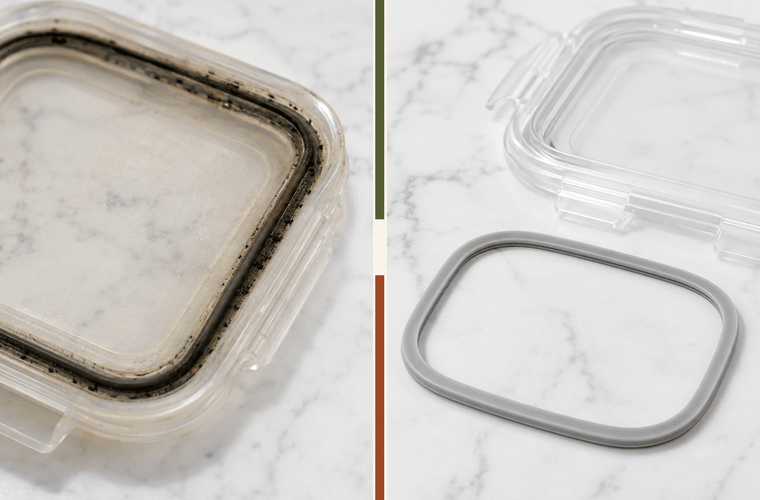
Lids matter as much as glass. A silicone-sealed snap-lock lid maintains its seal through repeated freeze-thaw cycles without warping or allowing air in. Plastic clip lids and press-fit lids can warp in cold temperatures, which breaks the airtight seal. Razab's glass meal prep containers use silicone-sealed lids built to maintain their seal across the full temperature range from freezer to oven.

What to Look for When Buying Freezer-Safe Glass Containers
|
The label 'freezer safe' on a glass container is not enough information. It may refer to the lid, not the glass itself. Before purchasing, confirm three things: the glass is borosilicate, the lid has a silicone seal rather than a press-fit or snap-clip only, and the container has a wide base with rounded corners rather than sharp 90-degree angles where stress concentrates. |
Sharp interior corners are a structural weak point in any glass container. Thermal stress concentrates at corners and edges rather than distributing evenly across the flat surfaces. Both containers that failed first in our test cracked at the corner junction of the base and sidewall. Wide, rounded base corners distribute stress more evenly and are significantly less likely to fracture under thermal cycling.
Lid material of any glass food storage container is the other variable most buyers overlook. A silicone gasket creates a full-perimeter seal that maintains elasticity across a wide temperature range. Silicone stays flexible at -20°F. Most plastics used in snap-clip lids become brittle and lose their seal at freezer temperatures which means the container is technically intact but no longer airtight, which defeats the point of sealed storage.
Borosilicate glass is not always labeled explicitly. Look for heat resistance specifications: containers rated for oven use at 400°F or higher are almost certainly borosilicate. Containers rated only for microwave or dishwasher use, without oven rating, may be tempered glass or soda-lime glass. When in doubt, contact the manufacturer and ask directly which glass type is used.
Frequently Asked Questions
Can you put glass containers in the freezer?
Yes, if they are made from borosilicate glass. Borosilicate's low thermal expansion coefficient means it barely changes size as temperatures drop, which prevents the cracking that affects standard glass. Tempered glass can crack under repeated freeze-thaw cycles. Standard soda-lime glass should not be frozen at all.
What glass is freezer safe?
Borosilicate glass is the only type that is reliably freezer safe for long-term repeated use. It has a thermal expansion coefficient of approximately 3.3 ppm per degree Celsius, about one-third that of standard glass. Tempered glass survives occasional freezer use but fails under repeated cycling. Standard soda-lime glass cracks in the freezer.
Why did my glass container crack in the freezer?
Almost certainly because the glass was not borosilicate. Tempered and standard glass have high thermal expansion rates that create internal stress during rapid temperature changes. That stress fractures the glass at weak points, typically corners and base edges. The crack usually appears at the first point of stress concentration, which is why base corners fail first.
How do you freeze food in glass containers without cracking?
Fill to 80 percent maximum to allow for expansion. Let hot food cool to room temperature before sealing and freezing. Never move glass directly from the oven or stovetop to the freezer. Thaw in the refrigerator overnight rather than at room temperature or under hot water. Use borosilicate glass with a silicone-sealed lid.
Is Razab glass borosilicate?
Yes. Razab glass food storage containers are made from borosilicate glass, which is why they are rated for both oven and freezer use. The silicone-sealed snap-lock lids maintain their airtight seal across the full temperature range. Razab glass food storage containers with lids are built specifically for the repeated temperature transitions that make standard glass fail.
Can tempered glass go in the freezer?
With caution, for occasional use. Tempered glass is mechanically strong and impact resistant, but its thermal expansion rate is similar to standard glass. Under repeated freeze-thaw cycling moving the container in and out of the freezer weekly over months, tempered glass builds cumulative internal stress that eventually causes it to crack. For regular freezer meal prep, borosilicate is the safer choice.
The containers that survived 30 days of repeated freezing had one thing in common: borosilicate glass. Not price. Not brand recognition. Not wall thickness. The glass type is the only variable that predicted the outcome.
Standard glass and tempered glass are not interchangeable with borosilicate in the freezer. The thermal expansion rates are simply too different. A container that looks identical to a borosilicate one but is made from soda-lime glass will crack — the only question is how many cycles it takes.
If you use glass containers for meal prep, batch cooking, or any regular freezer storage, the Razab glass food storage container collection is built from borosilicate and tested for exactly this kind of use. The test results above are what informed the design.
|
About the Author This post was produced by the Razab Product Research Team. Our team ran borosilicate glass containers through 30 consecutive freeze-thaw cycles at -20°F to confirm which glass construction actually survives the thermal stress that causes most glass to crack. Our mission is to help families reduce food waste through better storage science. |
Conversation
Join the discussion